


We Know Pain Affects Behavior. So Why Aren’t We Looking Harder?
by Suzi Moore
When “the vet said everything is fine” becomes the end of the conversation, what are we missing?
We know this stuff. Really, we do.
Ask a room full of qualified animal behavior professionals whether pain can contribute to behavior problems, and you’ll probably get a unanimous chorus of, “Of course!”
Aggression? Absolutely. Litter box problems? Sure. Irritability, overstimulation, withdrawal, handling sensitivity, changes in social relationships? Check, check, check.
We know that pain can cause behavior problems, aggravate existing ones, and interfere with behavior modification.
In fact, a 2020 review by Mills and colleagues reported that suspected painful conditions were identified in approximately 28% to 82% of cases across several canine behavior referral caseloads. Those are selected dog populations, not prevalence estimates for all pets, but even the low end is worth taking seriously.
So we know pain matters.
The question is whether we’re doing enough about it.
The Vet Said Everything Was Fine
It’s a conversation most of us have had countless times.
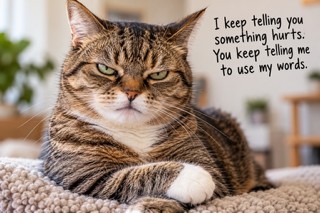
“Has your cat been examined by a veterinarian?”
“Yes.”
“Did they find anything?”
“Nope. Everything’s fine.”
And there it is. The magical phrase that can bring further investigation of physical discomfort to a screeching halt.
Not because we don’t believe pain is important. But because the cat has been examined, the veterinarian hasn’t identified a problem, and we’re behavior professionals—not veterinarians.
We don’t diagnose medical conditions. We don’t prescribe treatment. And we certainly don’t want to undermine the client’s confidence in their veterinarian.
So we move on.
But here’s the problem:
A normal veterinary examination and a thorough investigation of chronic pain are not necessarily the same thing.
Especially with cats.
Cats don’t exactly make this process easy.
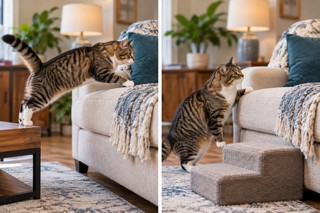
In a study of 100 cats over 12 years old, Hardie and colleagues (2002) found radiographic evidence of degenerative joint disease in 90%. Yet only 4% were reported to be lame.
Radiographic changes don’t necessarily mean clinically significant pain, but the absence of an obvious limp certainly doesn’t rule it out.
Cats can compensate for discomfort remarkably well. (They often hide the pain they are experiencing.)
Plus, chronic pain may affect multiple joints, making obvious asymmetry less apparent. And a frightened cat crouching motionless on an examination table isn’t necessarily providing a particularly useful demonstration of normal movement.
Meanwhile, at home, that same cat may be subtly shifting weight, shortening strides, avoiding certain movements, or changing how they interact with other animals.
And we may be hearing about the behavioral consequences without ever seeing the physical clues.
Effective Collaboration
Here’s where I think we need to challenge ourselves.
If you see something, say something. Then keep saying something.
When a client reports a sudden behavioral change, we appropriately recommend veterinary evaluation.
But what happens when the client comes back and says nothing was found?
Do we ask what was actually evaluated? Whether pain was specifically considered? Whether the veterinarian saw the cat moving naturally? Whether the client has noticed subtle changes in mobility?
Or do we check the “veterinary clearance” box and proceed with our behavior plan?
We shouldn’t be diagnosing pain. But we can recognize when something doesn’t add up, and we can help clients pursue further investigation.
Sometimes that means encouraging another conversation with their veterinarian, this time specifically addressing the possibility of pain. We can share our observations, help clients recognize and document subtle changes, and encourage them to discuss their concerns with the veterinary team.
Another Way to Look: The Gaitway Pain Screen
And sometimes further investigation means finding a different way to look at the animal.
“Nothing was found” isn’t necessarily the same as “nothing is wrong.”
This gap between recognizing the possibility of pain and actually identifying it is what prompted the development of Gaitway Pain Screen / Movement Analysis.
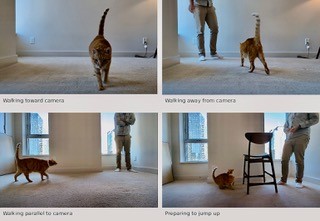
A structured home-video screening allows movement to be examined by a veterinarian, in detail, without the stress of a veterinary visit.
The concept is straightforward: rather than relying exclusively on what a cat demonstrates during a veterinary appointment, why not examine how that cat moves in his or her own home?
Guardians follow instructions for recording short videos of their cat from specific angles. A licensed veterinarian then reviews the footage in slow motion, examining weight distribution, muscle exertion, body mechanics, and possible compensatory movement patterns.
The findings are compiled into a report for the guardian and their regular veterinarian, including recommendations for further investigation when warranted.
It’s not a diagnostic test, and it certainly can’t identify every source of pain. Dental disease and gastrointestinal discomfort, for example, may have no detectable effect on gait.
But it can help identify subtle movement abnormalities that might otherwise go unnoticed—and provide the veterinarian with additional information to guide the next steps.
For cats who become fearful, defensive, or completely immobile in a veterinary setting, that information may be particularly valuable.
Gaitway isn’t a replacement for veterinary care. It’s a way to help make that care more informed.
And importantly, it’s an option behavior professionals can suggest when they’re concerned about possible musculoskeletal discomfort but don’t know what else to recommend.
Working Together
There’s another reason a thorough investigation of chronic pain matters.
A cat who experiences pain when approached, chased, handled, or groomed may develop lasting negative associations with those experiences.
We can implement carefully planned counterconditioning, improve resource distribution, manage interactions, and teach alternative behaviors.
But if the underlying discomfort remains, we may be asking the cat to learn that something is safe and pleasant when, physically, it still isn’t.
And even after pain is successfully treated, the learned associations may remain. That’s where our behavior modification expertise becomes essential.
Medical treatment and behavior modification aren’t competing approaches. They’re often complementary parts of the same solution.
Support for Pets and Their Guardians

We don’t need another lecture about the relationship between pain and behavior. We already understand it.
What we need is to make sure that understanding translates into action.
We can’t treat what we haven’t identified.
Ask more questions. Look for subtle changes. Encourage clients to document what they’re seeing at home. Communicate observations to the veterinary team. And when concerns remain unresolved, help clients understand that additional evaluation may be appropriate.
Tools like home-video movement screening give us another option when the usual examination hasn’t provided an answer.
Not every behavior problem involves pain. Not every painful condition will show up in a movement analysis.
But when we suspect physical discomfort, “the vet said everything is fine” shouldn’t automatically be the end of the investigation. Let’s not stop at, “The vet said everything is fine.”
Because the cat may still be hurting.
And unlike the rest of us, they can’t exactly schedule a second opinion.
References
Mills, D. S., et al. (2020). Pain and problem behavior in cats and dogs. Animals, 10*\(2), 318. https://doi.org/10.3390/ani10020318
Hardie, E. M., Roe, S. C., & Martin, F. R. (2002). Radiographic evidence of degenerative joint disease in geriatric cats: 100 cases (1994–1997). Journal of the American Veterinary Medical Association, 220(5), 628–632. https://doi.org/10.2460/javma.2002.220.628
Slingerland, L. I., et al. (2011). Cross-sectional study of the prevalence and clinical features of osteoarthritis in 100 cats. The Veterinary Journal, 187(3), 304–309. https://doi.org/10.1016/j.tvjl.2009.12.014
About the Author

Suzi Moore, LVT, CPDT-KA, CBCC-KA, is a licensed veterinary technician and animal behavior specialist with more than 40 years of experience working with animals. She specializes in feline behavior problems through Another Approach Behavior Solutions and developed the Gaitway Pain Screen / Movement Analysis service to help identify possible physical discomfort that may contribute to behavior problems.
Learn more about Gaitway Pain Screen / Movement Analysis.


Barks
Topics
Archives