


Choosing Litter: Part Two – Comparison of Different Types of Cat Litter
In Part One of this series of blog posts, we explored how to set up a preference test to help determine which litter your cats prefer. Now, let’s look at features that are important to people: clumping, amount of dust, tracking, odor control, cost, and sustainability.
Table 1 below summarizes my comparison of different types of cat litter, followed by more detailed descriptions of each of the features.
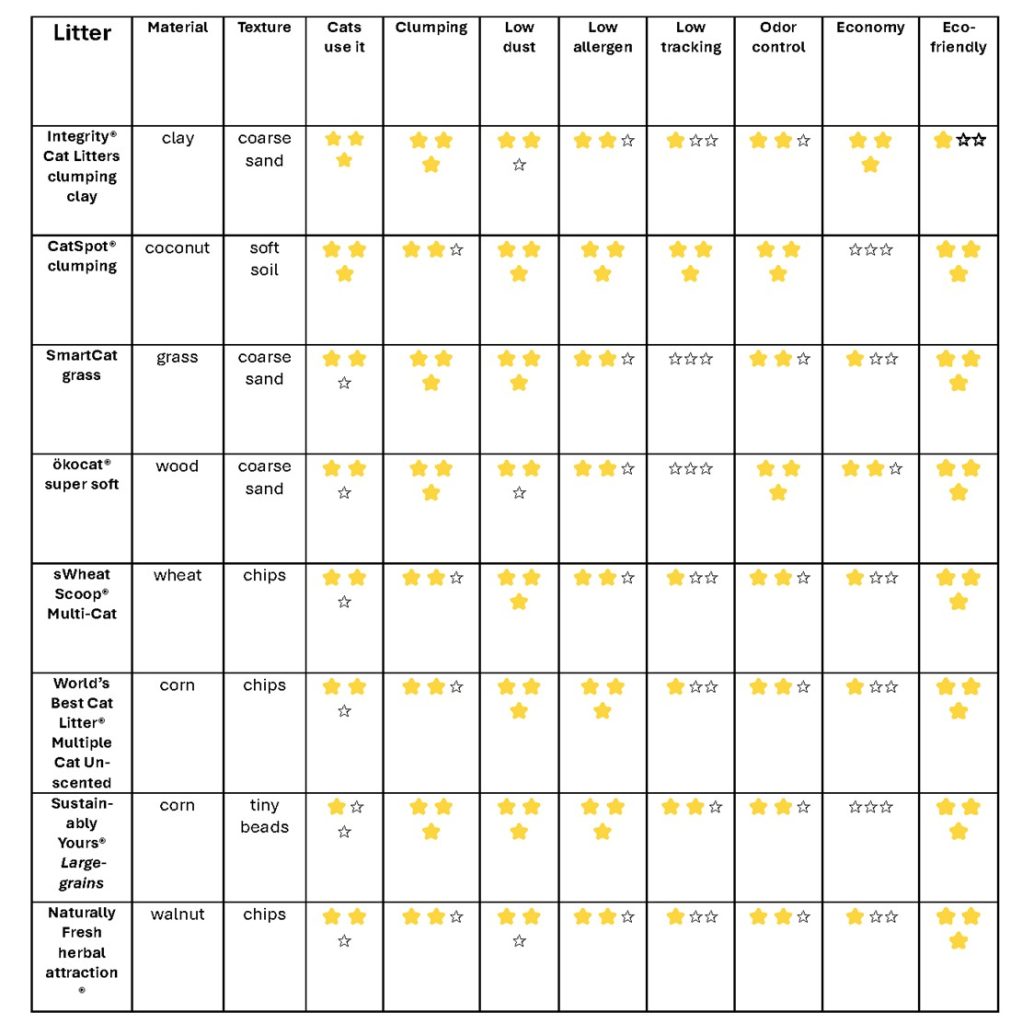
Cat Litter Features
Clumping
Clumping makes it easier to remove soiled litter which, in turn, eliminates odor.
It is recommended to scoop litter boxes at least once or twice daily.
Better yet, scoop litter each time it is used.
Non-clumping litters absorb urine. You scoop feces daily; empty and refill the litter weekly. These litters aren’t designed for heavy use. Odor control may be insufficient for multi-cat households. That’s a deal-breaker for me. I tried one type of non-clumping litter with my cats – cobbled paper – but they wouldn’t touch it.
For kittens, non-clumping non-toxic litter is safer, in case of ingestion. Instead of scooping, empty and refill litter once or twice daily. I asked the local cat rescue organization what kind of litter they use for kittens. They primarily use paper and wood pellets.
| Key: ⭐⭐⭐ = well-formed clumps ⭐⭐✰ = crumbly clumps ⭐✰✰ = poor clumping ✰✰✰ = no clumping |
Best in category – We found that clay, grass, and wood litter have the best clumping, with wheat, coconut, walnut, and corn second-best. There are some clumping pellet litters also, but my cats didn’t use them.
Low dust & low allergen
Low dust is important for households where pets or people have respiratory conditions or allergies. Dusty litter is unpleasant to refill, and it makes a mess. The types of litter we tried all had fairly low dust.
As of this writing, I found three litter brands claiming to be hypoallergenic: World’s Best Cat Litter®, Sustainably Yours®, and CatSpot®. However, since all sorts of allergies exist, it is possible for people and /or cats to be allergic to any kind of litter, even new varieties made from alternative materials (hemp, bamboo, etc.).
Avoid any known allergens for the individuals in your household when choosing cat litter.
If using a wheat, corn, or soy litter, be sure to keep it clean and dry to avoid mold.
| Key: ⭐⭐⭐ = very low ⭐⭐✰ = low ⭐✰✰ = moderate ✰✰✰ = high |
Best in category – The winner for me is CatSpot clumping coconut litter. It’s virtually dust-free and mold-resistant, and my cats use it. What’s best for your household will depend on individual allergen sensitivities.
Low tracking
No one likes stepping on cat litter, or finding it in the bed. Unfortunately, many litters cats like tend to be lightweight and tracks all over the house! Pellet litter tracks less because it’s fairly dense, but some cats don’t like the texture.
| Key: ⭐⭐⭐ = very low ⭐⭐✰ = low ⭐✰✰ = moderate ✰✰✰ = high |
Best in category – In terms of tracking, many of the litters we tried had a moderate to high amount of tracking. I was pleasantly surprised, however, with CatSpot coconut litter. It’s ultra light, with no noticeable tracking! Sustainably Yours corn litter also performed well.
Odor control
Cat urine is a powerful odor that most people find unpleasant and overwhelming. Therefore, odor control is a high priority when choosing cat litter.
| Key: ⭐⭐⭐ = best ⭐⭐✰ = better ⭐✰✰ = good ✰✰✰ = not helpful |
Best in category – The litters we tried all had good odor control. Coconut and wood litter seem to be the best. The ökocat super soft wood litter has a pleasant, piney aroma that eliminates the smell of cat urine.
Economical
It’s hard to accept spending a lot of money on cat litter, knowing that it will end up getting tossed.
Litter is sometimes priced by weight, but it’s volume that’s more relevant.
Here, I look at the cost to fill a large litter box – and keep it filled to an appropriate depth – for one month. All prices are as of June 2024.
| Key: ⭐⭐⭐ = least expensive ($10 and under) ⭐⭐✰ = mid-range ($11-15) ⭐✰✰ = high end ($16 – 20) ✰✰✰ = most expensive (over $20) |
Best in category – Most of the litters we tried are high-end, around $18 for a 14-lb. bag. The most economical for us is Integrity clay, followed by ökocat. The most expensive in our calculations is CatSpot coconut litter. It is only available through the CatSpot website. It comes in smaller bags, so you need to order twice as much, and you have to pay for shipping.
Eco-friendly
Most of the litters we tried are made from leftover or recycled materials and are biodegradable. There are two exceptions: clay and silica gel. Both are collected through mining and are non-biodegradable. Integrity brand does get a star because they replant trees from areas where clay is harvested.
| Key: ⭐⭐⭐ = best ⭐⭐✰ = better ⭐✰✰ = good ✰✰✰ = not eco-friendly |
Best in category – I’m giving the win to ökocat because it comes in a paper bag, which is easier to recycle than plastic.
Note: Some litters claim to be flushable or compostable, but this may not be possible in all areas. Usually, the safest way to dispose of used cat litter is to put it in the trash.
In Part Three of this series, I’ll summarize the key features of my overall top picks.
About the Author

Misty Hampton (CCBC, FFCP) is a cat trainer and behavior consultant and owner of Fellow Creatures Pet Consulting. She started teaching at age 12. For 13 years, she was an instructor for a home-schooling community. Since 2001, she has been a math and science tutor. Now, she is a life coach for teens and young adults as well. She also runs a birding club for Lake Oswego Parks & Recreation.
Her passion is helping people better understand misunderstood animals. She shares her life with her husband Jesse and their five cats: Linus, Jasper, Abigail, Pearl, and Piper.

Pets and Their People Blog
Topics
Archives