

Here’s Why You Should Care About Cooperative Care for Pets
by Misty Hampton
Poop happens. Sometimes, it’s messy!
My longhaired cat, Linus, sometimes gets feces stuck in his fur. When this happens, he hesitates to groom his rear end. (Who could blame him?!) We needed a way to clean the feces off his bottom, and I wanted to be able to do “sanitary trims” to prevent recurring poopy messes. It needed to be a cooperative procedure because I didn’t want him to be stressed. Historically, Linus tends to respond to restraint with aggression. If stressed and afraid, he’d likely struggle to get away, scratching us and spreading feces in the process. Eeeew!
What Is Cooperative Care?
Cooperative care is training an animal to be an active participant in their care, rather than just tolerate the procedure (Dixon et. al, 2018). Allowing the animal to take on an active role in handling and husbandry gives them more control, which improves welfare and strengthens the human-animal bond (Englund & Cronin, 2023; Rault et. al, 2020).
A Cooperative Care Case Study
The first time Linus, nicknamed King Fluffy Butt, had a messy poop incident, we tried two methods without success: using a warm washcloth to wipe his bum, and using baby scissors to cut off soiled fur. (I chose baby scissors because I didn’t want to risk poking him with sharp scissors.) We used the highest value treats to distract Linus. Still, he vocalized and swiped at us. It was clear he was stressed! So, we needed to find a kinder, less stressful option.
Then, my husband Jesse suggested that we use the electric clippers he uses for cutting his hair. I didn’t expect it to work, but it did! Linus focused on the treats and let us shave the soiled fur from his rear end.
After that, I ordered electric clippers made for trimming animal fur. The clippers are cordless and significantly quieter than the ones made for humans.
Yes, We Can Train Cats
While I was waiting for the new clippers to arrive, I started cooperative care training with Linus, using Jesse’s small electric clippers. My thinking was that if I progressed too fast in the training and Linus developed a fear of the clippers – if the clippers became a “poisoned cue” – at least it wasn’t the actual clippers I planned on using, so I could rebuild the training if needed.
Initially, we practiced familiar behaviors like following a target and doing high fives with the clippers on the table, nearby, for desensitization.
Next, I tried to get Linus to stand with his rear legs on a small wooden platform. Linus has a strong learning history of going onto step stools and chairs, so I thought it would be easy. It turned out, I could get Linus to stand with either his front or his back paws on the platform, but he would consistently raise or lower the rest of his body so his back was level. Apparently, I have a self-leveling cat!
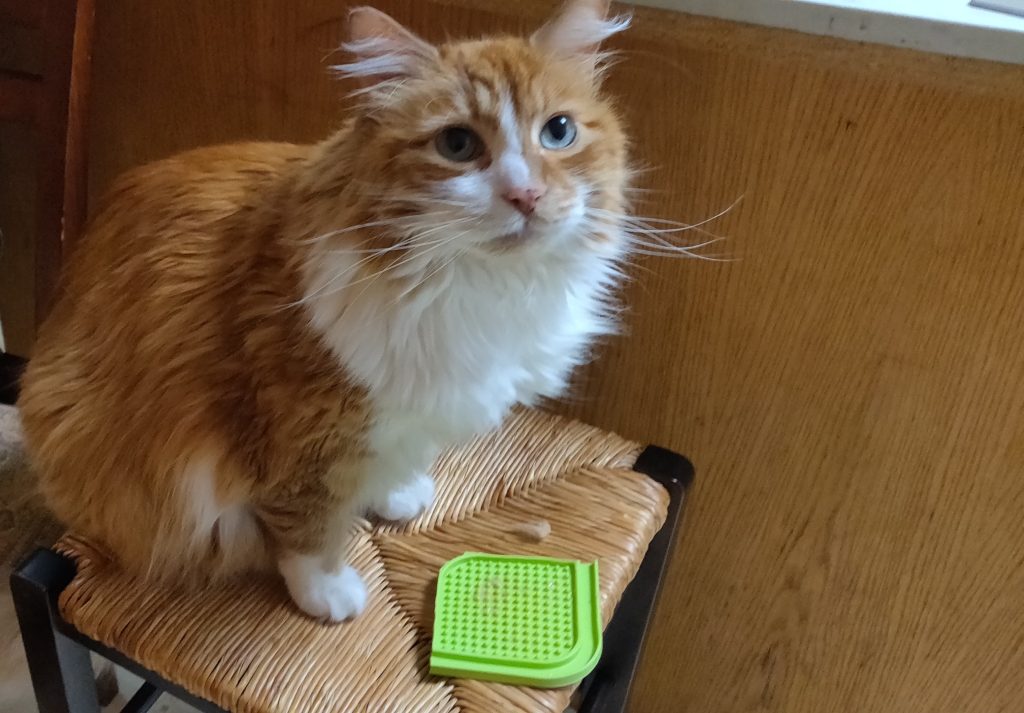
So, I gave up on having him stand on the platform. Now, I just place the lick mat (a textured mat that holds spreadable food) on the platform to provide a visual cue for Linus that we are going to work on the sanitary trim procedure.
What Are Start Buttons?
Eva Bertilsson and Emelie Johnson Vegh developed the concept of start button behavior. “Start button behaviors are behaviors that initiate a predictable sequence of events from the trainer” (Bertilsson, 2020). The animal does the start button behavior, which serves as a cue to the handler to proceed with a specific step, followed by delivering a reinforcer or reward to the animal. Start buttons – and the opposite, stop buttons – reduce fear, anxiety, and stress (FAS) by making interactions more predictable for the pet, and giving the animal choice and control, transforming training and care procedures into a dialogue instead of a one-way conversation.
Cooperation and Teamwork
In the beginning, my training mechanics were not very clean. I didn’t have a good understanding of how to properly train a start button behavior. (To be totally honest, my training is still sloppy at times. I don’t always have a plan, and my cues aren’t always clear.) We didn’t get this far because I’m such a skilled trainer.
Our success is due to the relationship we’ve built.
Really, it was communication and teamwork that got us to where we are. Linus is a great training partner!
Introducing the Clippers
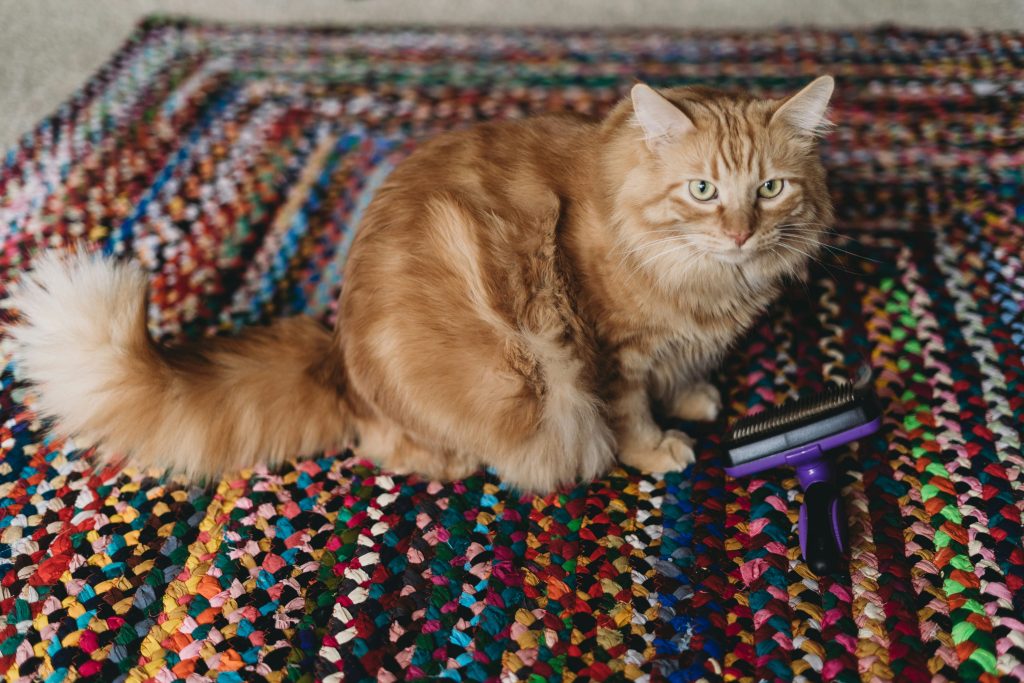
This is the initial process I followed when training the sanitary trim procedure.
Items on hand:
- Clippers
- Clicker
- Churu® (a treat Linus loves)
- Lick mat (licking can be both soothing and distracting)
Phase #1
- Show the small clippers.
- When Linus looks at the clippers, click. Put the clippers behind my back and put Churu on the lick mat in front of Linus.
- When Linus looks up after finishing the Churu, present the clippers again and repeat the process.
- Repeat this process over several sessions, gradually starting to bring the clippers closer (but not on every rep, so it’s not constantly getting harder).
Phase #2
- Starting with the clippers at a distance, turn them on briefly.
- When Linus looks at the clippers, click and turn them off. Put the clippers behind my back and put Churu on the lick mat, as before.
- When Linus looks up after finishing the Churu, present the clippers again and repeat the process.
- Then, start bringing the clippers closer after turning them on.
Check out the video.
At this point, the new clippers arrived in the mail. Since Linus had not shown any signs of fear, anxiety, or stress, we started the process over with the real clippers.
In parallel, I started to train the word “bottom” as a verbal predictor cue. I would give Linus Churu and, as he was licking it, I would say “pet” and start gently petting at the base of his tail. Then, I would say “bottom” and gently pet his rear end once. At first, he withdrew slightly, but then he got used to it and accepted my touch.
Because Linus has a history of overstimulation (meaning he tends to escalate his energy and swat or bite in response to excessive petting), I used a technique from Fear Free™ called the touch gradient (Martin, 2017).
What Is a Touch Gradient?
Using a touch gradient means you start petting in an area the animal is comfortable with, and move toward brief contact with more sensitive areas. I was mindful to maintain contact rather than touching Linus on and off, as that tends to get him more aroused (as evidenced by rapid purring, dilated pupils, shaking his tail, and grabbing or swatting). These behaviors could be excitement, frustration, or a combination. Either way, heightened emotions are not productive in the context of grooming!
I have learned that the clippers need to actually come in contact with Linus’ rear end in order to trim the hair effectively. If I just brush the clippers through the fluffy part of his fur, it doesn’t cut and Linus sidesteps away from the clippers. (I can only imagine that it tickles!)
Sanitary Trim Procedure
Here is what the procedure looks like for us now:
- I call Linus to the training station (table in the living room or bar stools in the kitchen).
- I present the clippers. When he looks at them, I turn them on and put Churu on the lick mat.
- If Linus keeps staring at the clippers and doesn’t go for the Churu, I turn off the clippers and try doing some high fives (an easier behavior that he’s familiar with) to build momentum.
- When he starts eating the Churu, I say “bottom” and stroke around the base of his tail. (He usually raises his rear end in response.) Then, I do a pass with the clippers.
- If Linus turns around to look at the clippers or if he sidesteps away from them, I pause and turn them off. When he goes back to eating the Churu, I turn them on and try again.
- This sequence is inspired by Chirag Patel’s Bucket Game, where a dog learns to focus on a bucket of treats during husbandry procedures (such as grooming or nail trims). If the dog looks at the handler instead of the treats, they pause the procedure. The difference here is the cat is actively eating the treats during the procedure, so technically, it’s more like voluntary distraction, but it’s functional. Fear Free teaches that it can be appropriate to use distractions for infrequent procedures with short duration, provided the animal shows zero to low FAS (fear, anxiety, and stress) throughout (Becker, 2025). Linus is well aware of what I’m doing, and he can opt out if he’s uncomfortable – and still receive reinforcement.
- Repeat the process as needed, until shaving is complete or until I think Linus has just about had enough.
- It’s better to keep it brief and end on a positive note than to push to get the job done and risk ruining the procedure with a negative association, making future handling and husbandry more difficult.
The Foundation of Cooperative Care Training
If Linus opts out twice in a row, or if he opts out three times in one session, I put a bit of Churu on the lick mat and end the session.
I want the animal to learn that they can say “no,” so I make it a point to give equal reinforcement for opting out (although I only click when they choose to opt in).
One might think that, given the choice, the animal would just opt out of procedures all the time, especially given the fact that studies have shown that cats prefer freely available food over working for food (Delgado et. al, 2021). Surprisingly, that’s not what happens with cooperative care.
Animals become more confident and less fearful when they know they have the option of saying, “No.”
Having a trusting relationship provides a foundation for cooperative care training. And, if you’re doing it right, the training itself is reinforcing, both because of the cognitive challenge and the value of the relationship.
The opt out simply gives me information as the handler, so I know I need to make it easier the next time.
Why Is Choice Essential?
Even positive reinforcement training can become coercive when the only choice the animal has is to perform the required behavior or forgo reinforcement (Layng, 2020). In this situation, animals often have conflicting emotions – they want the treats, but they’re afraid – which can result in bites when the animal dives in quickly to grab a treat. Taken to the extreme, coercion can result in either learned helplessness or defensive aggression. Given Linus’s history, in this case, I would predict the latter!
What’s next?
I’m interested in teaching Linus to target my hand with his hip, to give a more clear start button/opt in signal. That’s where I might go next. For now, the behavior is functional. Linus will even request to do the sanitary trim cooperative care procedure!
Recently, I presented two different (but familiar) grooming tools in front of Linus and he targeted the clippers by reaching out and touching them with a paw, then rubbing against them with his cheeks. That seemed to be a clear signal to me that he was choosing to work on the sanitary trim procedure.
Another time, Linus came into the kitchen meowing and I smelled poop. He hopped up on the bar stool and then I realized that he needed a sanitary trim to clean the feces off his rear end.
Afterwards, he rubbed up against me and purred. Cooperative care to the rescue!
About the Author
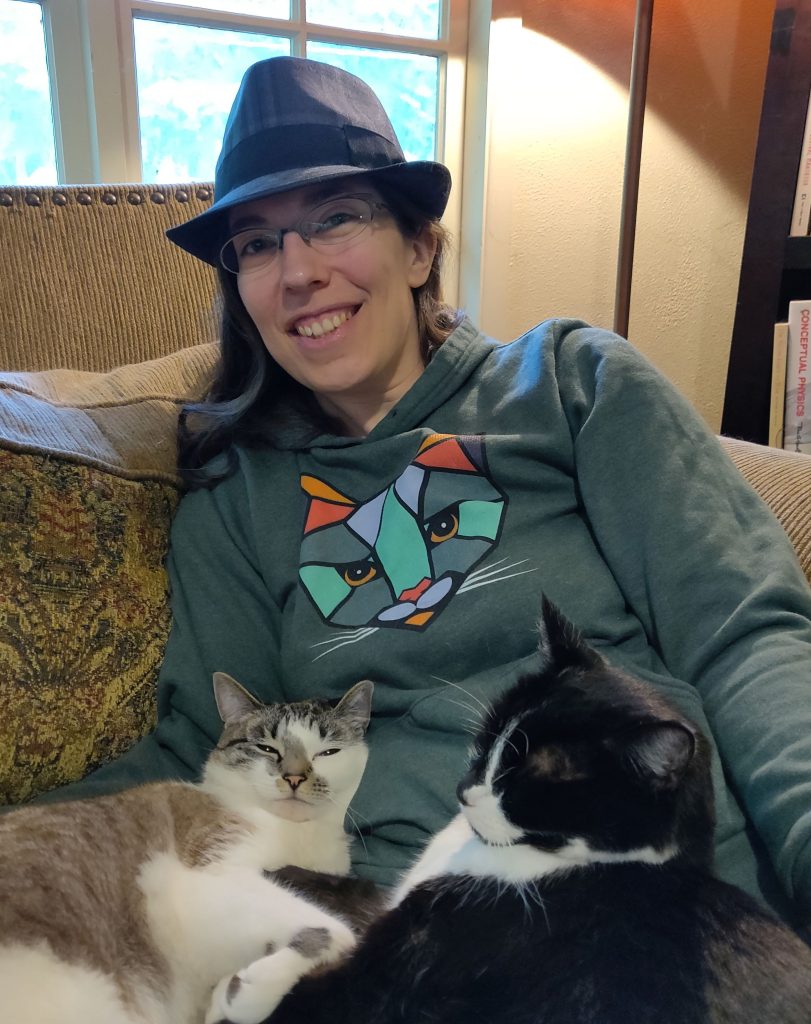
Misty Hampton (CCBC, FFCP) is a cat trainer and behavior consultant and owner of Fellow Creatures Pet Consulting. She started teaching at age 12. For 13 years, she was an instructor for a home-schooling community. Since 2001, she has been a math and science tutor. Now, she is a life coach for teens and young adults as well. She also runs a birding club for Lake Oswego Parks & Recreation.
Her passion is helping people better understand misunderstood animals. She shares her life with her husband Jesse and their five cats: Linus, Jasper, Abigail, Pearl, and Piper.
Cooperative Care Resources & References
Anderson, E. (2022, June 25). Not all “choices” are equal (choice: Part 1). Eileen and Dogs. https://eileenanddogs.com/blog/2015/06/19/giving-dogs-choices
Becker, L. (2025, April 29). Appropriate times to use distraction [Online Lesson]. Using Distractions: Fear Free Do’s and Don’ts. https://app.schoox.com/academy/FearFreePets /learner/course/9417478/about
Bertilsson, E. (2020). Start Button Behavior. https://evabertilsson.com/startbuttonbehavior
Delgado, M. M., Han, B. S. G., & Bain, M. J. (2021). Domestic cats (Felis catus) prefer freely available food over food that requires effort. Animal Cognition, 25(1). https://doi.org/10.1007/s10071-021-01530-3
Dixon, S., Fraser, L., & Edlund, S. (2018, October 25). What is Cooperative Care? IAABC Foundation Journal. https://journal.iaabcfoundation.org/cooperative-care
Englund, M. D., & Cronin, K. A. (2023). Choice, control, and Animal welfare: Definitions and Essential Inquiries to Advance Animal Welfare Science. Frontiers in Veterinary Science, 10. https://doi.org/10.3389/fvets.2023.1250251
Giljam, P. (2018, December 16). Why “choice and control” is a fashion statement. Zoospensefull. https://zoospensefull.com/2018/12/16/why-choice-and-control -is-a-fashion-statement
Layng, J. (2020, April 30). When R+ is Coercive and R- is Not. [Audio Podcast]. Animal Training Fundamentals with Barbara Heidenreich. https://animaltrainingfundamentals.com/podcasts/dr-joe-layng/
Martin, D. (2017). Fear FreeSM Techniques for Common Veterinary Procedures – WSAVA 2017 Congress – VIN. World Small Animal Veterinary Association Congress Proceedings. https://www.vin.com/apputil/content/defaultadv1.aspx?pId=20539&catId=113435&id=8506358&ind=412&objTypeID=17
Miller, P. (2025, March 26). Cooperative care for dogs: Giving your dog choice and control. Whole Dog Journal. https://www.whole-dog-journal.com/training/cooperative-care -giving-your-dog-choice-and-control
Rault, J.-L., Waiblinger, S., Boivin, X., & Hemsworth, P. (2020). The Power of a Positive Human–Animal Relationship for Animal Welfare. Frontiers in Veterinary Science, 7(1). https://doi.org/10.3389/fvets.2020.590867
Strong, E. (2023, May 24). Predictability, choice, control, oh my!. Pet Harmony. https://petharmonytraining.com/predictability-choice-control-oh-my
Westlund, K. (2025, February 21). The five P’s – the importance of considering emotions. ILLIS Animal Behavior. https://illis.se/en/five-ps

Pets and Their People Blog
Topics
Archives