


Whether to Offer Stuffed Toys to Your Dog Can Be a Messy Topic…So Let’s Tear into It!
by Daniel Antolec
There are many ways to provide dogs with enrichment, and providing stuffed toys is one of them. When I discuss this option with clients, many of them are already giving such toys to their pets, but sometimes I hear concerns about doing so. Let’s explore those concerns.
“Stuffed toys are too expensive, and my dog just tears them apart.”
Stuffed toys can be expensive, and they can also be quite affordable. Toys that I am willing to spend more money on are made of durable materials, though none have proven to be indestructible. Some are made with lots of fun stuff inside, such as squeakers, crunchy sounding plastic and even tug ropes. Avoid anything that may be harmful if ingested.
A cheap alternative might be found at thrift stores in bins full of stuffed toys (for kids). They are priced at pennies on the dollar, including those bearing cartoon and movie character brands.
I give them the squeeze test, palpating every inch of the toy in search of objects that may be harmful if ingested.
Those remain in the bin, and I walk away with safer treasures filled only with fluffy stuffing.
“What if my dog eats the stuff found inside the toy?”
Yes, that is a concern, especially for some dogs. Most dogs will put just about anything they can in their mouths. Some will swallow nonfood objects such as socks, small children’s toys, jewelry, coins, rocks, or who only knows what else! I know of some dogs who had emergency surgery after ingesting foreign items, so it is a good question to ask.
Of all the dogs I have enjoyed in my home, none ingested such things, including the innards of stuffed toys.
My safety advice is to supervise whatever toys they are given.
If my dog had a propensity to swallow things, I would only give him toys that he could not swallow whole or break apart. We must each know our own dog and do what we think is best for their welfare.
“When my dog rips apart the toy, it leaves a mess.”
True enough, but do parents complain that their kids “leave a mess” while playing, and then refuse them any more toys? When I see how joyfully dogs dissect toys and toss the stuffing hither and yon, it makes me happy to see how happy they are. Is that not one of the great benefits of living with a dog?
Besides, the “mess” provides opportunities for humorous photos and videos for social media (watch “Fern and Bruno make a mess”), allowing others to enjoy our dogs remotely. Consider the cleanup a minor task and take a pat on the back for making your dog so happy!
“I do not want my dog to start chewing on pillows or cushions.”
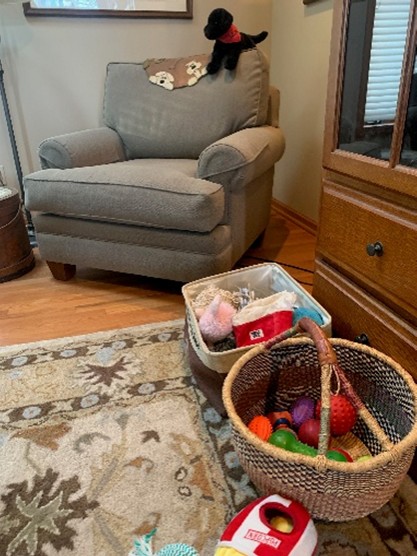
Neither do I, and that is another reason I give them stuffed toys. I have given hundreds of toys to dogs as their training graduation gifts. Each dog immediately began playing with the toy, as if they automatically made the distinction, and did not then begin ripping apart furniture. Not once.
If a dog does destroy pillows and cushions, I would consider what else could trigger your pet’s behavior, such as separation anxiety or boredom. And then meet the underlying need their behavior is communicating to you.
A stuffed black Lab toy (pictured) has rested atop a chair in our home, for years, near an ample supply of dog toys. With so many other fun options to choose from, no dog has ever shown interest in the stuffed Lab.
“Will giving stuffed toys to my dog make him aggressive, or attack animals?”
Based on my understanding of aggression and predation…which are two different things (see What Is Predation? below)…I would bet money the correct answer is, “No.”
Aggressive behavior may stem from a variety of things such as illness, fear, pain, conflict and more. For instance, if a dog is enjoying a toy and growls when a person approaches, I would suspect resource guarding might be the root cause.
That could be addressed through force-free application of training and behavior modification, with the help of a qualified canine professional. Another option is to allow your dog to enjoy the toy and let them be. I suggest the same if a dog is enjoying a meal, or a nap. Why bother the dog?
However, when a dog brings a toy to a person, that is probably an invitation to play. My Labrador, Bruno, does that daily. We are playmates, and there is no conflict or reason for either of us to be aggressive in that context.
What Is Predation?
Predation is a survival process, based in genetic code. Thousands of years ago, prehistoric dogs probably had the entire sequence of predatory behavior, or they would not have survived. This is how I describe it:
- Detect prey by sight, sound or smell.
- Stalk, to close the distance.
- Pounce/chase once prey is close enough.
- Grab/bite to kill the prey.
- Dissect.
- Consume.
Another way to consider this is the “four functional phases” of “search, approach, chase and bite.”
Fast-forward to 2026 and pet dogs have inherited bits and pieces of the predatory sequence, which may present as actual predation, or more ritualized play behavior.
Resource: Ethogram of the predatory sequence of dogs (Canis familiaris), Applied Animal Behavior Science, volume 279, October 2024, 106402. Anna Broseghini, Miina Looke, Cecile Guerineau, Lieta Marinelli, Paolo Mongillo. https://www.sciencedirect.com/science/article/pii/S0168159124002508
Some dogs, like my Labrador Gandhi, had the full sequence of predatory behavior and if given the opportunity, would act it out. With management and force-free training, I could override his instinct. Gandhi never displayed any aggression toward people or dogs and was an experienced dog daycare player and a registered therapy dog.
Bruno, on the other extreme, seems to have no predatory drive with any of the wildlife he encounters daily, as you can see in this video (Bruno & Turkeys). He does, however, have a rich history of stuffed toy destruction. He also enjoys frequent dog-dog and dog-human play and has never shown any aggressive behavior.
In conclusion, consider giving your dog stuffed toys, if it is safe for them to enjoy. It is a great stress-reliever and enables a dog to act out some snippets of canine prey drive, with no harm…except perhaps to the toy.
About the Author
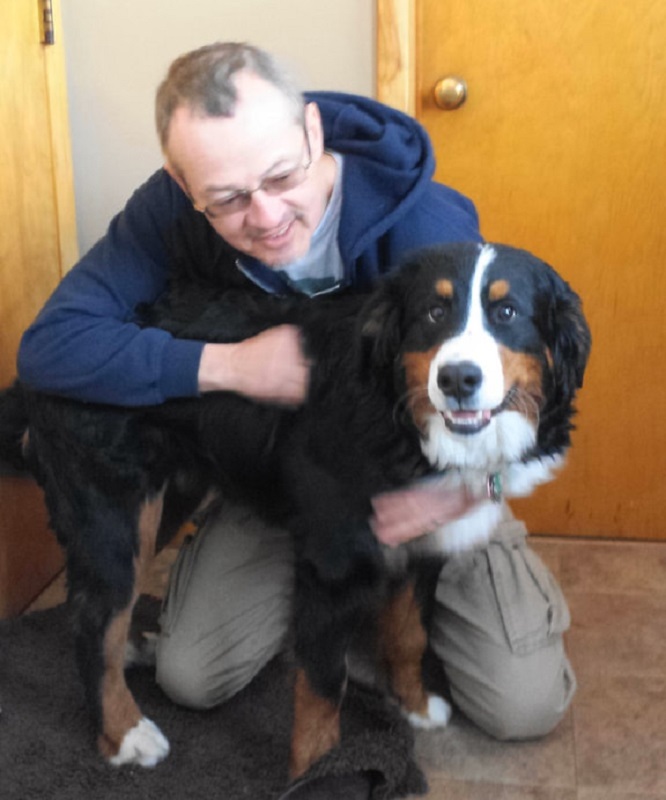
Daniel H. Antolec, PCT-A, CCBC-KA, CPDT-KA began teaching dogs in 2011 and founded Happy Buddha Dog Training. He teaches dogs in a way that makes it fun for pet stewards and pets alike.
In Loving Memory of Jackson. (Pictured here with Dan.)

Pets and Their People Blog
Topics
Archives