

From Hourly to High-Value: A Strategic Guide to Pricing and Packaging Your Pet Training Services
by Niki Tudge
Many pet trainers fall into a common trap: they view themselves as laborers selling their time by the hour. But when you trade time for money, you cap your income and risk burnout. To build a sustainable, profitable business, you must shift your mindset from selling “hours” to selling “results.”
This guide covers how to restructure your pricing, protect your income with solid policies, and market your services to attract the right clients.
The Psychology of Price: Pricing IS Marketing
Before you open a spreadsheet, you must understand that your price is the loudest signal your brand sends. It tells a story about your quality, your confidence, and your ideal client before they ever read your website.
- The “Walmart” Signal: Low prices suggest you are a volume-based, “basic” option. This often attracts bargain hunters who are less compliant and more likely to haggle.
- The “Mercedes” Signal: Premium prices suggest you are an exclusive expert. This attracts clients who view training as an investment and are committed to the process.
The Golden Rule: You cannot market yourself as a “Premium Behavior Expert” while pricing yourself like a discount chain. If your marketing claims you save lives but your price is $40/hour, you create cognitive dissonance. Clients will wonder, “If they are really that good, why are they so cheap?”
Market Research: How to Find Your Number
Do not simply copy what the trainer down the street is charging; their business model might be failing. Instead, triangulate your price using these three methods:

1. The “Mystery Shopper” Scan
Look at your top five competitors. Don’t just look at the price tag; look at the structure.
- Are they selling single sessions or packages?
- What is their response time?
- Do they offer “value-adds” like video libraries or support groups?
The Goal: Find the gap. If everyone offers “Basic Obedience,” offer a “Puppy Survival Concierge” service.
2. The “Economic Proxy”
If you can’t find reliable local data, look at other personalized service industries in your zip code.
- Private Personal Trainers: Dog training usually sits at 1.0–1.5x the cost of a human personal training session.
- High-End Salons: The price of a “Cut and Color” often mirrors the price of a comprehensive initial behavior consult.
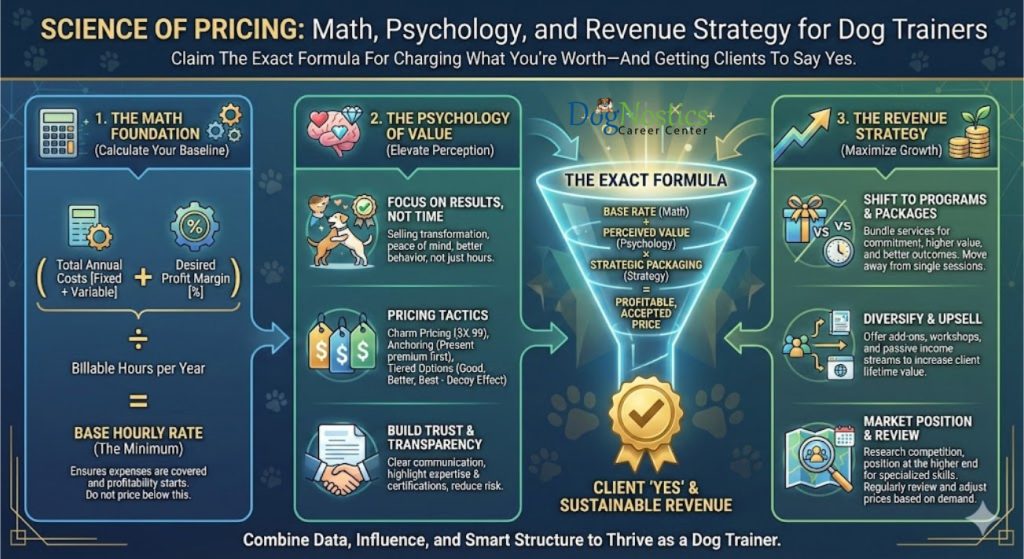
3. The Formula
Finally, run your Cost of Doing Business (CODB):
(Expenses + Desired Salary) \ (Billable Hours) = Minimum Hourly Rate
Remember: You likely only have 15–20 billable training hours per week. The rest is admin, travel, and marketing.
The “Program” Model: Stop Selling Hours
The most profitable move you can make is switching from “Packages” (6 sessions for $X) to “Programs.”
A program sells a comprehensive solution. It allows you to charge for your expertise and materials, not just your physical presence.
Example:
The “Puppy Start-Right” Foundation ($297–$497)
Instead of selling “6 Puppy Classes,” you sell a bundle:
- 6 Live Sessions (the time)
- The “Puppy Survival” PDF Binder (potty training, nipping, socialization checklists)
- Video Library Access (lifetime access to homework videos)
- The Hardware (a treat pouch and clicker included)
- VIP Support (private Facebook group access)
Why this works: The client feels they are getting massive value (calculated at $500+), while you are simply leveraging digital assets you created once.
Yield Management: Maximizing Your Calendar
Airlines and hotels change prices based on demand. You should, too. Your inventory (your time) is perishable; if a slot goes empty, that revenue is lost forever.
- Prime vs. Standard Time: Most clients want evenings and weekends. Charge a premium for these “prime” slots, or reserve them exclusively for your highest-tier programs. Offer a lower rate for Tuesday mornings to fill your calendar.
- The “Urgency” Premium: Keep one or two “emergency slots” open per week. If a client needs an immediate consultation for a biting dog, offer them this slot at a higher “priority rate” rather than making them wait three weeks.
- The “Standby” List: If you have a last-minute cancellation, text your existing client list: “I have a pop-up session available tomorrow at 10 AM. First to reply gets it for 20% off.” This recovers revenue that would have otherwise been $0.
Converting the Client: Calls to Action
Once your pricing is set, you need to get them to book. Avoid the generic “Submit” button. Tailor your calls to action (CTAs) to the client’s pain point.
- For Puppy Classes: Change “Sign Up” to “Enroll Your Puppy Now” or “Start Right with Your Puppy.”
- For Behavior Modification: Change “Contact” to “Get Help with Aggression” or “Schedule Your Relief Call.”
- For Scarcity: Use “Only 2 Spots Left” or “Book Before Prices Go Up.”
Design Tip: Testing shows that first-person text often converts better. Try “Get MY Free Guide” instead of “Get YOUR Free Guide.”
Protecting Your Business: Essential Policies
Your policies protect your time and prevent “scope creep.” These should be clearly outlined in your client agreement.
- Cancellation Policy: “Cancellations must be made at least 24 hours in advance. Late cancellations result in the forfeiture of the session.”
- Refund Policy: “No refunds are provided for services already rendered. Unused program sessions may be refunded minus a 20% admin fee.”
- Expiration Date: “All programs must be completed within 4 months. Unused sessions after this date are forfeited.” (This encourages training consistency).
- Results Disclaimer: “Because animal behavior involves living creatures and owner compliance, [Business Name] does not guarantee specific training results. Success depends on your commitment to the homework.”
Conclusion
Pricing is not just math; it is the foundation of a healthy, ethical business. By moving to a program model, using yield management to control your calendar, and protecting yourself with clear policies, you ensure that you can afford to keep doing the work you love—helping dogs and their humans.
Want to learn more?
Come and join my webinar in January 2026:
The Science of Pricing: Math, Psychology, and Revenue Strategy for Dog Trainers

Niki Tudge, MBA, PCBC-A, CABC, CDBC, is the founder and president of the Pet Professional Guild, DogNostics Education and The DogSmith. She has substantial leadership experience in business management and administration, particularly in the nonprofit sector, which encompasses her role as the president of Doggone Safe, a nonprofit educational organization. She has published numerous articles, which have been featured in publications such as the New York Times. She has also authored five books. Her most recent book, Pet Training and Behavior Consulting: A Model for Raising the bar to Protect Professionals, Pets and Their People, which she co-authored, was published in 2019.
Niki holds a dog training and dog behavior credential from the Pet Professional Accreditation Board, has successfully completed two diplomas (animal behavior technician and canine behavior science and technology) with James O’Heare at the Companion Animal Sciences Institute, and is a certified dog trainer and dog behavior consultant through the Association of Animal Behavior Professionals.
Before following her passion into small business and nonprofit management, she enjoyed a distinguished career in the hospitality industry, holding executive positions all over the world. Her real passion in her corporate role was the identification and development of female talent in the workplace. She enjoyed managing and coaching her team through both their personal and professional development, and loved watching the process of female empowerment and growth at a high level of management.
In recent years, Niki has invested time in moving her love of running from a hobby to a professional business. Her professional credentials include International Sports Science Association (ISSA) certified fitness trainer, ISSA certified transformation specialist, nutritional coach and ISSA elite trainer. She is also a certified chi walking and running coach, and has successfully complete the MAF Foundations’ certificate course.
Along with her business degrees from Oxford Brookes University in the UK, Niki holds a Six Sigma Black Belt certification, specializing in data analysis and process improvement and is an International Training Board (HCITB) certified people trainer at levels TS1, TS2 and TS3, and a certified facilitator and project manager. In addition, she was recognized for her outstanding contribution to the business community and honored with a Fortune 500 Company Leadership Award for her accomplishments.

Barks
Topics
Archives