


Keep Calm and Kitty On: Relaxation and Resilience Strategies for Cats
by Misty Hampton
The purpose of this article is to identify techniques and tools that can be used to help cats navigate stressful situations, and to develop the resilience to cope with stressors on their own, when you aren’t there to help them.
With cats, it’s considered by some “normal” for them to hide under the bed all day when there are visitors in the house but, undoubtedly, that cat is experiencing stress. And, it’s well known that chronic stress negatively impacts health and longevity. The best way we can protect our pets from chronic stress is to reduce the stressors we can control, and gently teach them to cope with those we can’t.
What Causes Stress for Cats?
Some of the most common stressors for cats include changes in the home environment or daily routine; inter-cat conflict (competition for resources); a poor human–cat relationship; and frustration over being unable to perform natural behaviors, such as climbing up onto elevated surfaces and scratching (Amat, et. al, 2015).
Trigger Stacking – Depending on the conditions, stress hormones can take hours or even days to leave the body (Bender, 2021). When multiple stressors have a cumulative effect over time, this is called trigger stacking. Trigger stacking explains why a cat might seem “fine” one day and then start eliminating outside the litter box the next day. From the cat’s perspective, the litter box conditions may have been barely tolerable. Things were OK, until the combined effect of multiple stressors made the litter box “the last straw.”
Some cats are more prone to chronic stress than others. An individual cat’s ability to cope with stressors depends on a combination of genetic factors and their life experiences, including prenatal stress and early socialization. If a mother cat experiences major stress during pregnancy – illness, injury, or poor nutrition, for example – it can make her kittens more susceptible to stress-related issues later in life (International Cat Care, 2024).
Factors that determine the impact of stress include intensity, duration, frequency, and the type of stressor. For humans, “stress is most likely to be harmful when … it feels against your will, out of your control and utterly devoid of meaning” (Parker, 2015). While it’s not possible for us to help cats find meaning in the challenges they face – they may not even experience such a thing – we can help them have a sense of control, by teaching them coping strategies and building resilience.
Resilience
Resilience is an individual’s ability to resist and recover from the negative effects of stress – the ability to “bounce back” (Bhambree & Murphy, 2024). Resilience exercises for pets can be active, such as interactive play, food puzzles, and pattern games; or more passive, like relaxing on a mat, cuddling, or going to a safe room.
Behavior Vets developed the Resilience Rainbow, defining seven domains of resilience: Decompression, Safety & Security, Completing the Stress Cycle, Mental & Physical Well-Being, Predictability, Social Support, and Agency (Bhambree & Murphy, 2024). Their 2024 article for the IAABC Foundation Journal focuses on dogs. The following table gives examples for cats.
| Domain | Examples |
|---|---|
| Mental & Physical Well-Being | veterinary checkup, nutrition consultation, enrichment |
| Completing the Stress Cycle | interactive play, training, food puzzles, scratching posts, kicker toys, zoomies |
| Decompression | relaxation training: relax on a mat, go to safe room |
| Safety & Security | identify and manage triggers, desensitization & counterconditioning, safe room |
| Social Support | calmly being near them, grooming, petting and cuddling, shared naptime |
| Predictability | daily routine, pattern games, appropriate human-cat interactions |
| Agency | offering choices – free access to different places/things, or presenting the cat with different options; training with start & stop signals; training mands – cues where the animal requests what they want from the person |
Mental and Physical Well-Being
Before we can start building resilience, we need to address any underlying health issues, manage pain, and ensure that the cat’s needs are met. With those boxes checked, let’s move on to the main subject of the article, resilience strategies.
Completing the Stress Cycle
As humans, we often engage in cognitive problem-solving, but our evolutionary biology has us primed to respond physically to danger. We can recognize conceptually when a threat has passed, but if we do not engage in any physical activity, the body doesn’t break down the stress hormones (Nagoski & Nagoski, 2020). As a consequence, individuals, all vertebrate animals in fact, who lead a fairly sedentary lifestyle are more likely to experience a buildup of stress hormones.
Therefore, it is important that we provide our cats – especially those who live exclusively indoors – with opportunities to complete the stress cycle with physical activity. Strategies to promote SEEKING in cats include interactive play, food puzzles, scent enrichment, and clicker training.
SEEKING
Dr. Jaak Panksepp pioneered the field of affective neuroscience, defining seven primary emotional systems: SEEKING, RAGE, FEAR, CARE, LUST, PANIC (grief), and PLAY (joy). These emotions are customarily written in all capital letters, to indicate that they are formally defined terms.
In all mammals, SEEKING promotes positive anticipation and drives exploration. The primary neurotransmitter involved in the SEEKING system is dopamine, the reward hormone (Alcaro & Panksepp, 2011). Dopamine gets released when we experience something pleasurable. It helps us learn what is rewarding, and motivates us to seek out those experiences again – thus the name SEEKING. The opposite of SEEKING is FEAR and depression (Wright & Panksepp, 2012).
Scent Enrichment
It is estimated that cats have between 45- and 200 million scent receptors, compared to 5 million in humans (Williams et. al, 2024). Their sense of smell is much more sensitive than ours. Cats who live exclusively indoors miss out on the plethora of scents they would encounter in the wild. Providing scent enrichment can help a cat relax because it allows them to utilize their SEEKING system and get out of fight-or-flight mode. One challenge with using scent enrichment is that a majority of plants are actually toxic to cats. A good option is Meowy Janes Herbal Scent Enrichment Kit. It contains 13 different nontoxic herbs that are safe for cats.
Decompression
It’s helpful to consider what the individual already knows. Every individual has their own learning history. Even the mind of a kitten is not a blank slate. (They wouldn’t have made it this far in life without some behaviors that work for them.) Recognizing what the individual already does in times of stress and building on that foundation will make it more likely that your training will be successful.
Relaxation Training
As caring people, we want to protect pets, but we cannot – and should not – shield them from every stressor. Stress is part of life for every organism. One of the most useful techniques for helping cats cope with stress is relaxation training.
Safe Room
Most cats instinctively hide when they feel threatened, which makes the safe room a natural choice. Think of where the cat goes when they’re scared. Since the cat already sees that room as a safe space, make that their safe room.
Set up the room with all the cat’s essentials: litter box; feeding station and water (spaced a ways apart, neither one next to the litter box); a cozy bed, a hiding space, and elevated perches (if the room does not already provide them); a scratcher; and a variety of rotating enrichment (outside view, cat TV, play tunnel, solo toys, etc.).
Lead the cat into the room. (You can call the cat’s name or use the 1-2-3 Game, a pattern game developed by dog trainer Leslie McDevitt.) Avoid picking the cat up or shooing them into the room, as that would most likely result in a negative emotional association.
Turn off the lights and close the door, creating a quiet sanctuary.
Spend time in the room with the cat, interacting with them in a way they enjoy: grooming, petting, or cuddling; or engaging in a calm, low-energy activity such as reading. Plan to spend at least 20 minutes during the first few sessions. When the cat gets more comfortable – as evidenced by slow blinks; deep breaths; and sprawling out, napping – take a short break (5 minutes or less) and come back, all the while, keeping the safe room door closed.
Gradually, work up to leaving the cat in the safe room for longer periods on their own. Make sure to give the cat plenty of attention when you’re in the room with them, and give them something to do when you leave – rotating toys and enrichment items.
We want the cat to experience the safe room as a good place to be, so the room will take on a positive conditioned emotional response (CER).
Once conditioned, the safe room can be used proactively when you anticipate stressful events – such as fireworks, or repeated knocking at the door – or to redirect a cat from unwanted behavior – such as fighting with another cat. The cat can even learn to go to the safe room on their own, when they need to decompress. In multi-cat households where there is conflict between the cats, when one cat goes to their safe room, you may see them visibly relax when you close the door.
Happy Place
My cat Jasper has a special location in the safe room where he seeks comfort. I call this his “happy place.” After exploring other parts of the house, Jasper gets to go to his happy place – the hideaway closet – to unwind. The other cats don’t have access to this area, and he only goes in there when I can supervise him.
Ideally, a cat’s happy place would be their carrier. It’s worth investing time to create a positive CER with the carrier. If the cat had a negative experience with the carrier in the past and they’re showing signs of fear, start fresh with a new carrier – one that looks (and smells) different – and use a process of desensitization and counterconditioning (DS/CC). Sometimes, finding a carrier that the cat is comfortable with requires some creativity. Jasper’s carrier is actually a bassinet made for human babies.
It is essential that the cat does not perceive the safe room as a time-out. A time-out creates a negative emotional response, leading to increased fear and anxiety. Punishment of any kind is not appropriate for cats. Since cats are much smaller than humans, when we try to punish a cat, it often backfires and makes them afraid of us. It goes without saying that fear is counterproductive to relaxation and well-being.
If the safe room has been used for time-outs in the past, learning will likely progress more slowly. That’s because, previously, when you put them in that room, you were removing them from something they wanted and leaving them alone, with nothing to do. You can either start fresh with a different room or continue using that room – if it’s the cat’s preferred safe space – knowing that progress will be slower.
Separation Training
If the cat starts crying or scratching at the door when you’re outside the room, wait for a brief moment of calm before opening the door, to avoid reinforcing undesirable behavior. Then, work on separation training.
Cats are known for their independent spirit, but some cats become very attached to their people and can be – quite literally – clingy.
Insecure-anxious attachment is associated with separation-related problems (SRPs) in dogs (Konok et al., 2019). Although SRPs are less common in cats, they’re not unheard of, especially with many people adopting pets during the pandemic of 2020, and now transitioning back to working away from home.
For cats who are prone to SRPs, it’s necessary to build their confidence, so they realize that they’re OK on their own. Separation training involves using a process of gradual desensitization and counterconditioning to teach the cat to accept you leaving the room.
A similar process could be used for cats who exhibit nervous behavior – crouched posture, wide-eyed, glancing around, ears turned sideways, lip-licking – when the door is closed. Remain in the room with them while you work up to closing the door.
Baby steps are key! How many steps are needed depends on the cat’s temperament and their learning experience. The idea is for the cat to learn that there are things to do while you’re away; and you’ll be back, you’re not abandoning them.
For a cat you suspect has a serious SRP, it’s recommended to work with a professional who specializes in this type of training.
Mat Training
Mat training is using a towel, blanket, or mat (flat cat bed) to create a portable relaxation station. Once conditioned, the mat can be used to teach the cat to go to the safe room or go in their carrier, and to relax in different settings. I find it works especially well for outgoing cats who have less of a tendency to hide, but still need a way to calm down when they’re overwhelmed.
To teach a cat to relax on a mat, be mindful of your posture and energy. If you are in a calm frame of mind, your body language and behavior will reflect that, and the cat will pick up on it. If, on the other hand, your movement is frantic, it will distract the cat, making it difficult for them to relax. Do your relaxation work beforehand, to make sure you’re going into training in a calm state. Additionally, you will need a:
- Location where the cat is comfortable
- Time when the cat is likely to be relaxed
- Bed, blanket, or towel – something you’ve seen them lay on before, so you know they like it. Don’t use their favorite bed, because we don’t want to take that away from them. Choose something else to create a clear context for training.
- Reinforcer that the cat enjoys, but not a high-value reinforcer that’s likely to get the cat excited. (Do not use a clicker either, for this reason.) I used kibble, different from my cats’ regular food, for this exercise, but you could easily use brushing or petting as a reinforcer instead, if the cat enjoys it and doesn’t get too excited.

To shape relaxing on a mat, call the cat over to the mat. Use a soft verbal marker and slowly place a treat in front of them. If the cat leans forward to eat the treat, almost like they’re laying down, verbally mark and reinforce that movement. Then, watch for any signs of relaxation. It can be a big change like settling onto their haunches, or something subtle like slowing down, relaxing their muscles, or softening their gaze. Deliver the treat a short distance in front of them, so they are more likely to lay down.
Continue shaping increasingly relaxed body language, until the cat is noticeably relaxed, for instance, laying down, sprawled out, or with paws tucked in a “cat loaf” position. Eyes may be slightly closed. There should be no tension in the face (refer to the Feline Grimace Scale). The cat might even be purring. The exact position is not important, as long as the cat is relaxed. This transition can be difficult for clicker-savvy cats who expect to be in “training mode,” or for kittens who are full of energy.
Remember, we aren’t looking for robotic obedience, but relaxation. You can take a deep breath yourself, to encourage the cat to relax. Loosen up your shoulders and soften your gaze. Focus off to the side instead of staring at the cat (because cats perceive staring as threatening). You can verbally mark and reinforce even the smallest shift – if the cat releases energy with a deep breath, for example.
To learn more, I recommend Dr. Chris Pachel’s presentation, available through dog-ibox: Chill out – incorporating conditioned relaxation techniques into behavioral therapy.
You can also use capturing to train a cat to relax on a mat. The disadvantage is learning will be slower, because the training context is not as clear. You’re marking a behavior that the cat is already doing, hoping they will form the association with that particular mat. It’s likely that you will get in fewer reps per session.
Emotional Support Object
Another option is to train the cat to recognize a particular object as a cue for relaxation. This is inspired by Peta Clarke’s work, using river rocks as emotional support objects for her dog, Quinn.
Start by thinking of a context (location, time, and people) where the cat is relaxed. It is essential that the cat feels safe, in order for them to learn a positive association. Choose a neutral object – something that the cat has no association with, and thus, no reaction to (assuming you don’t already have an object that elicits the desired response). It’s important that it be a neutral object, not something exciting or scary. Don’t choose something that looks like a cat toy or prey, because it won’t reliably help the cat relax. Choose something that can be found throughout the house, so the cat can generalize and eventually seek out the object to help them relax.
Present the object and then proceed to shape relaxation, as with mat training. You can help the cat relax by laying down and relaxing, yourself. Repeat this process over many days. Always present the object at the start of the relaxation training, so they form an association. During training, keep the object nearby. Over time, watch for the cat to orient toward the object, as you begin the relaxation exercise. Then, add a cue.
Once the cue is established, you can present the object and cue the cat to relax, or you can use the cue to remind the cat to seek out the object themself. As with any cue, avoid using it in intense situations, when the cat is overwhelmed and unlikely to respond. You don’t want to create a negative association – a “poisoned cue.”
It took months of training, but once Peta Clarke’s dog, Quinn, had learned the association, he started to invent his own games, using river rocks to initiate and guide interactions – both with other dogs and with people. I’m currently training my cat, Jasper, to use an emotional support object. I’m not sure if Jasper will get that far, but I hope that he will be able to seek out his emotional support objects in the future, when he needs to decompress.
Safety & Security
Relaxation strategies will be ineffective – the cat won’t be able to relax – if they don’t feel safe.
Desensitization & Counterconditioning
For triggers we cannot eliminate – from dogs barking and vehicles driving by, to vacuum cleaners and visitors, and handling for grooming and health care procedures – we can use a process of desensitization and counterconditioning (DS/CC) to reduce stress. Although many of these triggers are acute stressors, they can lead to chronic stress over time through trigger-stacking.
As with separation training, baby steps are key! Exposure to the trigger must be gradual, keeping below the threshold at all times, so as not to elicit a fearful response.
People tend to get impatient and try to progress quickly, but that risks overwhelming the cat and causing sensitization instead. Teaching coping skills is completely different from flooding, in which an individual is subjected to a feared stimulus at overwhelming intensity, in an effort to get them to accept it. Rather than accomplishing desensitization, flooding often results in extreme fear, anxiety, aggression or learned helplessness.
I like to tell clients that you really can’t go too slow with this type of training.
Because it’s easy to rush the process and make things worse, I recommend clients do DS/CC procedures with the guidance of a professional, whenever possible.
Social Support
Coregulation is a mutual adaptation process whereby two partners support each other, emotionally. Coregulation involves biological (hormones and nervous system), affective, and cognitive elements. Human babies develop the capacity for self-regulation through coregulation with their parents (Bornstein & Esposito, 2023). Much like children, dogs engage in coregulation with their people (Koskela et. al, 2024). The idea that all mammals have the capacity for coregulation is consistent with polyvagal theory (Sunseri, 2024).
Anyone who has had a pet comfort them when they were sad will attest that they are capable of coregulation.
The best part about coregulation is that it works both ways! Just as your cat can comfort you when you’re sad, you can help your cat relax when they’re stressed.
Choose a location where you can be comfortable and the cat feels safe – as evidenced by relaxed body language. Pick a time of day when the cat is likely to be relaxed, such as after a meal. Set up the environment so it’s relaxing – both for you and the cat. Low light and soft music can help set the mood. Get down on the cat’s level and slow-blink at them. Slow-blinks are thought to be a calming signal for cats (Humphrey et. al, 2020).
Rest with the cat or engage in a low-energy activity such as meditation or reading. Over time, part of the context – perhaps the soft music – will become a cue that tells the cat you’re offering an opportunity to relax together. (You could use an intentional cue, if you prefer.)
I’m using coregulation to teach Jasper to use an emotional support object, so he can use it to cue me when he wants to relax together. He might eventually use it to find comfort on his own.
Predictability
Having predictable interactions with humans can go a long way toward reducing a cat’s fear. It’s up to us, as humans, to ensure that we are creating positive, predictable interactions for cats. It takes time to build trust with cats, particularly if they haven’t had positive experiences with people during the critical socialization period – 2 to 7 weeks of age (Lindell et. al, 2023).
For people, a greater awareness of cat body language and understanding how cats typically interact – as well as the individual cat’s preferences – can facilitate better interactions. When cats greet each other, first, they sniff; then, they briefly rub cheeks. Cats who are closely bonded will snuggle and groom each other. We can use this information to inform how we interact with cats (Farly & Rodan, 2021).
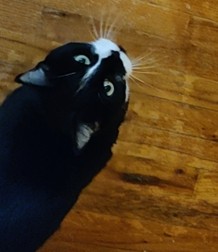
Rather than approaching the cat, invite them to interact.
Take a deep breath, relax your posture, and soften your gaze. (Avoid staring directly at the cat or looming over them, since that could be intimidating.) Extend a finger for the cat to sniff and rub against. Limit petting to the head and neck, initially. Most cats enjoy gentle scratching “scritches” along the cheeks and chin. Some cats like petting on the head and around the ears.
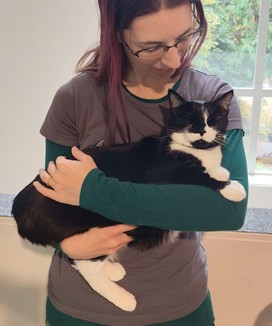
Many cats are sensitive to petting at the base of the tail. While some cats will raise their rear end up and purr with delight, for others, touching their rear end is uncomfortable or even painful. It is best not to touch a cat’s rear end unless you know they like it. Long strokes along the body are usually a no-go, as is touching the cat’s belly. People who are used to dogs may see a cat stretched out, belly-up, and think the cat wants a belly rub, but what it actually means is that the cat trusts you and can relax in your presence. For the vast majority of cats, it is not a request for a belly rub. I liken petting the cat’s belly to poking someone’s navel when they are having a good stretch. Rude!
Avoid picking the cat up unless they request it. Generally, being picked up or restrained is very scary for cats, because they lose all sense of control. It’s better to train the cat to come to their name and to follow a target, or to entice the cat with treats or toys to get them to go where you want them to be. Carrier training is helpful, so the cat can go in their carrier voluntarily, rather than needing to be picked up, which would cause more stress and potentially result in cat and/or human injury.
If you want to pick up a cat, ask yourself why. Is it really necessary, or can you invite the cat up instead? If it is necessary to pick up the cat periodically, cats can be trained to be picked up through cooperative care training. This gives the cat the chance to say “yes” or “no” to being picked up – through their behavior.
If you’re going to pick up a cat, always use both hands – one under the cat’s rear end and the other supporting their chest. Lifting a cat by the scruff is never recommended. Even if the cat doesn’t struggle, that doesn’t mean they aren’t stressed. For heavier cats, scruffing is painful!
If you need to handle a cat and they have not learned a cooperative procedure – or if you anticipate the interaction being especially stressful – use a predictor cue. A colleague of mine says “no choice” when she needs to pick up her cat. The benefit of a predictor cue is it allows the cat to relax in its absence.
Agency
Another way to create predictable interactions for cats is using dog trainer Leslie McDevitt’s Control Unleashed pattern games: Look At That (LAT), Request Approach Training (RAT), and Super Bowls. Pattern games help cats feel safe because, once they learn the structure, they know what to expect. Built into these games are ways for the cat to indicate when they are ready for the next step, and when they need to take a break. Having a sense of control over their interactions with people allows the cat to feel more secure.
Conclusion
In this article, I have presented a variety of strategies to help cats relax: completing the stress cycle through activities that promote SEEKING, going to a mat or safe room, using an emotional support object, replacing fear with a positive conditioned emotional response (CER) through desensitization and counterconditioning, receiving support through coregulation, and taking comfort in predictable interactions.
Cats hide when they’re afraid, but that’s not the end of the story! We can help them experience less stress through proactive management and training, helping them to be resilient and thrive.
About the Author
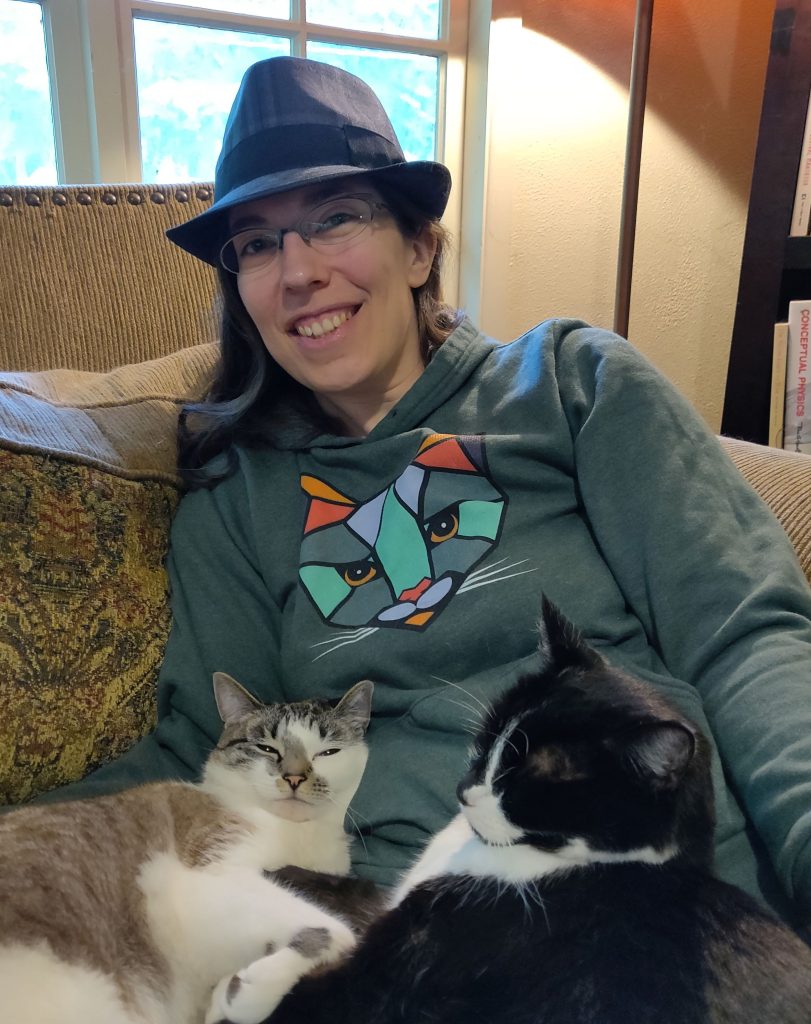
Misty Hampton (CCBC, FFCP) is a cat trainer and behavior consultant and owner of Fellow Creatures Pet Consulting . She started teaching at age 12. For 13 years, she was an instructor for a home-schooling community. Since 2001, she has been a math and science tutor. Now, she is a life coach for teens and young adults as well. She also runs a birding club for Lake Oswego Parks & Recreation.
Her passion is helping people better understand misunderstood animals. She shares her life with her husband Jesse and their five cats: Linus, Jasper, Abigail, Pearl, and Piper.

A PPG Webinar: Keep Calm and Kitty On: Relaxation & Resilience Strategies for Cats with Misty Hampton
There are lots of tools and strategies to help dogs cope with stressful situations. But with cats, it’s a different story. It’s considered normal for them to hide for hours when, undoubtedly, they’re experiencing stress. We can do better!
In this webinar, learn strategies to help cats navigate stressful situations and to develop the resilience to cope with stressors on their own when you aren’t there to help them. The presentation will include demo videos of mat relaxation and desensitization to separation.
Article References & Resources
Alcaro, A., & Panksepp, J. (2011). The SEEKING mind: Primal neuro-affective substrates for appetitive incentive states and their pathological dynamics in addictions and depression. Neuroscience & Biobehavioral Reviews, 35(9), 1805–1820. https://doi.org/10.1016/j.neubiorev.2011.03.002
Amat, M., Camps, T., & Manteca, X. (2015). Stress in owned cats: behavioural changes and welfare implications. Journal of Feline Medicine and Surgery, 18(8), 577–586. https://doi.org/10.1177/1098612×15590867
Bender, A. (2021, September 8). What You Need to Know About Trigger Stacking – Pet Harmony. Pet Harmony Training. https://petharmonytraining.com/what-you-need-to-know-about-trigger-stacking
Bhambree, B., & Murphy, K. (2023, February 14). A Framework for Behavior Modification and Training Plans to Help Build and Maintain Resilience: The Resilience Rainbow. IAABC Foundation Journal. https://journal.iaabcfoundation.org/the-resilience-rainbow
Bornstein, M. H., & Esposito, G. (2023). Coregulation: A Multilevel Approach via Biology and Behavior. Children, 10(8), 1323. https://doi.org/10.3390/children10081323
Cats Protection. (2022, March 28). Does my cat have separation anxiety? Cats Protection. https://www.cats.org.uk/cats-blog/does-my-cat-have-separation-anxiety
Chu, B., Marwaha, K., Sanvictores, T., & Ayers, D. (2024, May 7). Physiology, Stress Reaction. PubMed; StatPearls Publishing. https://www.ncbi.nlm.nih.gov/books/NBK541120
de Souza Machado, D., Oliveira, P. M. B., Machado, J. C., Ceballos, M. C., & Sant’Anna, A. C. (2020). Identification of separation-related problems in domestic cats: A questionnaire survey. PLOS ONE, 15(4), e0230999. https://doi.org/10.1371/journal.pone.0230999
Dyer Animal Clinic. (2024, July 8). Common Signs of Stress in Cats. Dyer Animal Clinic. https://dyeranimalclinic.com/blog/stress-in-cats
Farly, I., & Rodan, I. (2021, August 19). How to Pet and Handle Cats. Cat Friendly Homes by the Feline VMA. https://catfriendly.com/be-a-cat-friendly-caregiver/best-ways-handle-pet-cats
Humphrey, T., Stringer, F., Proops, L., & McComb, K. (2020). Slow Blink Eye Closure in Shelter Cats Is Related to Quicker Adoption. Animals, 10(12), 2256. https://doi.org/10.3390/ani10122256
International Cat Care. (2024, November 28). Stress in cats. International Cat Care. https://icatcare.org/articles/stress-in-cats
Johnson, D. (2020, July 21). Separation-Related Problems in Cats. IAABC Foundation Journal. https://journal.iaabcfoundation.org/separation-related-problems-in-cats
Konok, V., Marx, A., & Faragó, T. (2019). Attachment styles in dogs and their relationship with separation-related disorder – A questionnaire based clustering. Applied Animal Behaviour Science, 213(ISSN 0168-1591), 81–90. https://doi.org/10.1016/j.applanim.2019.02.014
Koskela, A., Heini Törnqvist, Somppi, S., Katriina Tiira, Virpi-Liisa Kykyri, Hänninen, L., Kujala, J., Nagasawa, M., Takefumi Kikusui, & Kujala, M. V. (2024). Behavioral and emotional co-modulation during dog–owner interaction measured by heart rate variability and activity. Scientific Reports, 14(1). https://doi.org/10.1038/s41598-024-76831-x
Lindell, E., Feyrecilde, M., Horwitz, D., & Landsberg, G. (2023). Socialization and Fear Prevention in Kittens. VCA Animal Hospitals. https://vcahospitals.com/know-your-pet/socialization-and-fear-prevention-in-kittens
Meowy Janes (Carly & Bill). (2020). Catnip, Silvervine or Valerian Root- What’s The Difference? Meowy Janes. https://meowyjanes.com/catnip-silvervine-or-valerian-root-whats-the-difference
Nagoski, E., & Nagoski, A. (2020). BURNOUT : the secret to solving the stress cycle. Vermilion.
Parker, C. (2015, May 7). Stanford Report. Stanford University. https://news.stanford.edu/stories/2015/05/embracing-stress-is-more-important-than-reducing-stress,-stanford-psychologist-says
Richter, C. (2025, December). The Unhappy Cat: Handling Behavior Issues in Cats. Fear Free Pets.
Sunseri, J. (2020, October 28). Pets & Co-regulation. Justin LMFT. https://www.justinlmft.com/post/pets-co-regulation
Williams, K., Llera, R., & Buzhardt, L. (2024). Why Cats Sniff Rear Ends. VCA Animal Hospitals. https://vcahospitals.com/know-your-pet/why-cats-sniff-butts
Wright, J. S., & Panksepp, J. (2012). An Evolutionary Framework to Understand Foraging, Wanting, and Desire: The Neuropsychology of the SEEKING System. Neuropsychoanalysis, 14(1), 5–39. https://doi.org/10.1080/15294145.2012.10773683

Barks
Topics
Archives