


Cat Adoption: Considerations for Multi-Cat Homes
by Misty Hampton
Understanding cats’ natural behavior can help us create and maintain more peaceful multi-cat homes.
A Look at the Lifestyles of Free-Roaming Cats
Territory
Cats are often thought of as antisocial, but that isn’t really accurate. Cats are solitary hunters. Their prey isn’t big enough to share. So each cat needs to establish their own territory for hunting.
A cat’s territory is the area they will actively defend. Within the territory is the core territory, where the cat feels safe enough to play, eat, groom, and sleep, and potentially enjoy social interaction.
Cats’ territories may overlap, with neutral areas in between. If an unfamiliar cat enters another cat’s territory, they are met with a warning: staring, hissing, and growling. If that doesn’t work, the resident cat may chase and attack the intruder (iCatCare, 2025).
Cats mark their territories using scent and pheromones. In this way, they leave messages for each other, so they can communicate in an effort to prevent direct conflict (iCatCare, 2025).
Cat Colonies
Colonies, or social groups, form in areas where food is available (Crowell-Davis et. al, 2004).
Cats from the same colony will approach each other with a friendly tail-up signal, nose-touch, and walk past each other, rubbing along each other’s sides (allorubbing). Then, they might sniff each other’s rear ends. Sometimes, they will walk side-by-side with tails entwined.
Cats who are from the same colony will scratch and rub their cheeks on objects in the area, creating a “group scent.”
The social behavior of free-roaming cats is quite variable. Some colonies have groups with strong social bonds, while others are more loosely associated (Vitale, 2022).
When cats form social groups, they aren’t random.

Groups are commonly made up of related queens (mother cats) who share the work of caring for kittens. Group living offers greater protection from intruding males and predators. Male cats usually live on the periphery, with large territories that overlap with other cats (iCatCare, 2025).
Feline Friends
Cats form friendships with other cats they like to be close to. Scientists call them “preferred associates” (Crowell-Davis et. al, 2004). A cat’s preferred associates are most often relatives or other familiar cats (Vitale, 2022). With the exception of breeding adults, there is no effect of gender on which cats are preferred associates. With spayed and neutered cats, gender doesn’t matter (Crowell-Davis et. al, 2004).
Cats who are preferred associates often groom each other and sleep together, in close physical contact.
Dominance Does Not Apply
The word “dominant” often gets incorrectly applied to cats (and dogs). In animal behavior studies, “dominance” has a specific meaning, including but not limited to, having priority access to resources. And, cats don’t have a rigid social structure. While some cats may have priority access to certain resources in different situations, these relationships are always in flux; there is no fixed dominance hierarchy.
Conflict
Physical fights within a group are infrequent.
Instead, cats use body posturing (such as lowering the ears slightly, turning the head away and leaning back) to diffuse tension and avoid fighting.
When conflict does occur, it’s usually when male kittens reach sexual maturity. They get kicked out of the group and have to go and establish their own territory (iCatCare, 2025). This serves to prevent inbreeding.
Interactions between intact toms (unneutered male cats) are mostly characterized by avoidance and tolerance, sometimes aggression.
Outsiders are met with aggression. If a non-colony member is persistent, they may eventually be integrated into the group, but only after many interactions (Crowell-Davis et. al, 2004).
Socialization
Individual cats have different personalities and different levels of sociability.
A cat’s personality is shaped by genetics and their learning history (Finka, 2022). It includes traits like: activity level, boldness vs. fearfulness, sociability toward other cats, and sociability toward humans.
The period from two to seven weeks is the critical socialization period for kittens. During that time, they learn how to interact with the world, and they form their attitudes toward other cats and toward humans.
Kittens learn from their mothers how to interact with humans. They will socialize to humans more readily if their mother is calm in the presence of people (Vitale, 2022).
Kittens who grow up without their mother or without littermates miss out on important learning experiences, so, they won’t learn how to interact appropriately with other cats. Their lack of social communication skills can show up as excessive fear or aggression (Crowell-Davis et. al, 2019).
Tips for a More Peaceful Multi-Cat Home
Social groups of cats tend to work best when the members are familiar with each other and there is no competition for resources (iCatCare, 2025). With that in mind, people who wish to have a multi-cat household might do better by adopting littermates, or a mother cat with one or more of her kittens (Crowell-Davis et. al, 2019) – although there’s still no guarantee they will all get along once they reach social maturity.
People & Pets
It is also important to consider the personalities and energy levels of everyone in the home – the people and any resident pets.
Think about your lifestyle and what you want your relationship with the new cat to look like. Make sure you have realistic expectations. How important is it to you that the cat be a cuddly lap cat?
Remember, every cat is an individual.
Some cats are more cuddly, and some cats are more independent. But make no mistake, cats aren’t low-maintenance pets! There really is no such thing.
If you can’t keep up with a lot of playful energy, don’t adopt a kitten.
Please don’t make the mistake of adopting a kitten as a companion for a senior cat! That makes for a tough introduction. The kitten gets frustrated because they want to play, and the senior cat gets stressed because the kitten won’t leave them alone. It doesn’t create a good foundation for the cats to get along.
If you’ve recently lost a cat, remember to give the new cat a fresh start. They can’t replace the one you lost.
Every relationship is unique.
Age & Activity Level
If you plan to have a multi-cat home and want to make a successful match, activity level is more important than age. It may actually be the most important factor.
That said, kittens are easier to introduce to each other. The disadvantage is you don’t really know their personalities. When you adopt a kitten, they haven’t experienced much of the world yet. Their personality is still forming, so you don’t really know who you’ll get. Will the kitten grow up to be a lap cat, a couch potato, or an adventurous explorer…?
Cats reach social maturity somewhere between a year and a half and four years old.
That’s when their personality is fully developed. Of course, they can still learn and change their behavior, but their essential personality stays the same.
When you adopt an adult cat, you get to see more of their personality.
But often, much of their backstory is a mystery. More on that later.
Gender, Breed, & Coat Color
Some breeds are known for their activity level. Bengals, for instance, are high-energy, agile and curious. Ragdolls are the opposite. They are known for their docile temperament. A cat’s breed doesn’t need to be an important consideration, unless you’re looking for either extreme. Most cats are mixed breeds. If you are looking for a specific breed, it’s important to look for a reputable, responsible breeder and understand that breed’s predispositions towards heritable medical issues.
If the cats are spayed and neutered, gender doesn’t matter.
Size could be a factor if the more assertive cat is much larger.
Judging a cat’s personality can be highly subjective. Things like a cat’s gender, breed, and coat color can impact how we perceive their personality, and we can’t help but be influenced by our own personality and previous experiences. For example, if I grew up with two cats in my family, a friendly orange male and a shy Siamese female, I might think that orange cats are more friendly than Siamese cats, and that male cats are more outgoing than females. And that may or may not be true of the new cats I meet. It’s worth taking a closer look at your assumptions and biases, so you can really see each cat as an individual.
Getting to Know New Cats
It can be hard to judge a cat’s personality when you meet them in a shelter. Shelters are stressful environments, so the cat is probably going to be scared, not showing their true personality and their full range of behaviors.
Even in a foster home, it can be hard to know for sure. For example, just because the cat lived peacefully with a dog in the foster home, there is no guarantee the cat will get along with all dogs in any context. Animals (humans included) tend to generalize negative experiences when our brains are in survival mode. Meaning if a cat is chased by a dog in their previous home, the cat will probably assume that all dogs are scary (better safe than sorry). But if they have a positive experience, it doesn’t necessarily translate. Getting along with one dog doesn’t mean all dogs are OK. Maybe the previous dog was an older dog who slept most of the time and ignored the cat, but the new home has a puppy. That’s not the same!
If you take in a cat who was previously living outdoors, it can be even more challenging, especially if the cat is undersocialized and doesn’t trust humans. With cats who are undersocialized, it takes longer for them to settle in and feel safe in the home, before you can fully see their personality.
One of the best ways to get to know a cat is through a foster-to-adopt program.
By fostering the cat, you get to see how they act in your home environment. After some time, you could introduce them to your resident pets to see if they get along. Of course, this is not always possible. Not all rescues have a foster-to-adopt program. And some cats find their way into our lives by other means.
Realistically, the best we can do is to find out what is known about the kitten’s or cat’s background and make the best judgement that we can to avoid obvious mismatches.
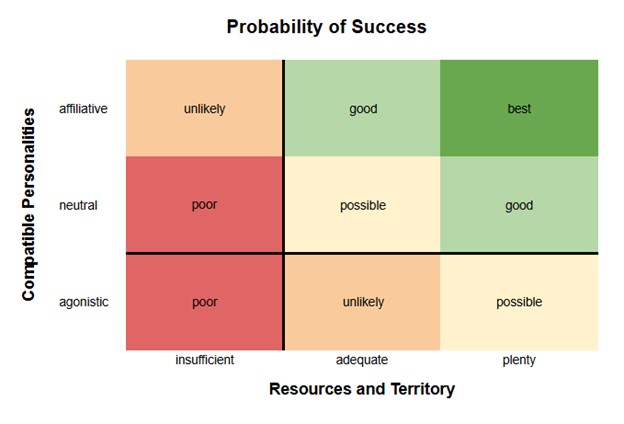
To maximize the probability of a successful introduction, it’s important to try to choose cats with compatible personalities, and to ensure that there are plenty of resources spread out throughout the home, so there’s no need for competition.
About the Author
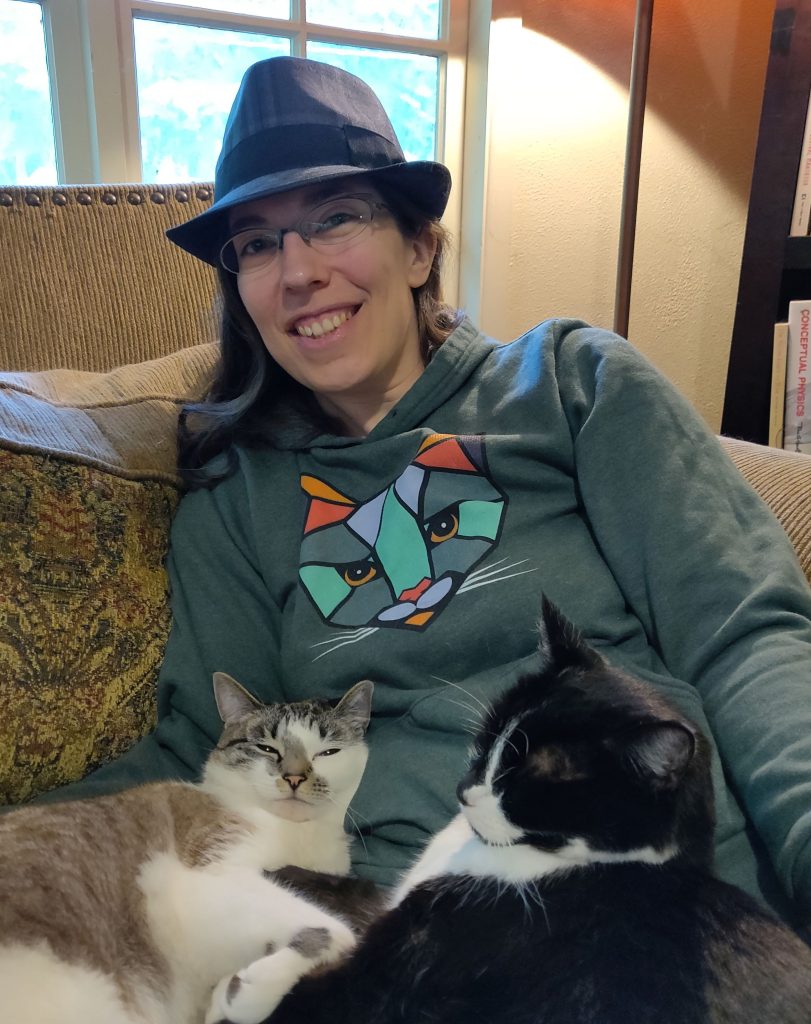
Misty Hampton (CCBC, FFCP) is a cat trainer and behavior consultant and owner of Fellow Creatures Pet Consulting. She started teaching at age 12. For 13 years, she was an instructor for a home-schooling community. Since 2001, she has been a math and science tutor. Now, she is a life coach for teens and young adults as well. She also runs a birding club for Lake Oswego Parks & Recreation.
Her passion is helping people better understand misunderstood animals. She shares her life with her husband Jesse and their five cats: Linus, Jasper, Abigail, Pearl, and Piper.
References & Resources
Crowell-Davis, S. L., Curtis, T. M., & Knowles, R. J. (2004). Social organization in the cat: A modern understanding. Journal of Feline Medicine and Surgery, 6(1), 19–28. https://doi.org/10.1016/j.jfms.2003.09.013
Finka, L. R. (2022). Conspecific and Human Sociality in the Domestic Cat: Consideration of Proximate Mechanisms, Human Selection and Implications for Cat Welfare. Animals, 12(3), 298. https://doi.org/10.3390/ani12030298
International Cat Care. (2025). The social structure of cat life. Icatcare.org. https://icatcare.org/articles/the-social-structure-of-cat-life#understanding-the-social-structure-of-cats
Vitale KR. The Social Lives of Free-Ranging Cats. Animals (Basel). 2022 Jan 5;12(1):126. doi: 10.3390/ani12010126. PMID: 35011232; PMCID: PMC8749887

Pets and Their People Blog
Topics
Archives