


Dog Training for the Real World
by Daniel H. Antolec
Is your dog prepared to cope with the “real world”?
Recently, I saw social media posts from two force-free trainers offering helpful tips. Each post was attacked by Trolls, using identical language, asserting that reward-based training falls apart in the “real world.” Some personal insults were added for acidic tone.

It seems common for proponents of aversive methods (choke, prong, shock) to attack force-free (no fear, no force, no pain) practitioners online, and it appears this “real world” text is the meme du jour.
However, that assertion contradicts my “real-world” experiences with each of my dogs, Buddha and Gandhi in particular.
They were my Labrador registered therapy dogs, who had robust predatory drives for their breed, and yet responded excellently in a wide variety of “real-world” situations, such as when they spotted wildlife or were in busy environments.
So I wondered…“What gives?”
Stages of Learning
The answer is found on two sides of the same coin. On one side, the aversive trainers cited failure of some dogs to respond in the face of distraction.
That is not a failure of reward-based training, but a human failure in completing the education process.
One can hardly wonder why their dog did not perform as expected, when put in a situation they were not prepared for.
The opposite side of the coin is that I completed the force-free, reward-based education process for Buddha and Gandhi and always saw them succeed.
I embrace a fundamental understanding that training and learning occur in stages. If the teacher and learner work through each stage, they will see better success than if they stop short.
Success is based on preparation and dog training for the real world is a process.
My understanding of that process is as follows:
Make Learning Fun
We begin teaching a task, such as to ‘wait’ on cue. The technical term for this step is acquisition.
It works best to begin in a calm and quiet environment, with plenty of practice and rewards for effort, gradually increasing the challenge.
I liken beginning training stages to my memory of sitting on the floor in a kindergarten class as the teacher led us in repeated sing-song recital of the alphabet. It was fun and I enjoyed success while learning. Who among us does not remember that?
Then, my teacher gave me a “Dick and Jane” book to practice reading. The book consisted of lots of illustrations, short words and simple sentences.
Learning to read was made fun by the positive reinforcement from my teacher, which is why I still remember the experience approaching 70 years of age!
Reward-based training is resilient.
What if my teacher then gave me Hamlet to read? No doubt I would have failed, and what if my teacher then declared, “The boy is stubborn. He only reads when he wants to!”
My teachers were smarter than that and helped me through the generalization stage. That meant giving me a wider variety of simple books to enjoy.
Practice in New Places
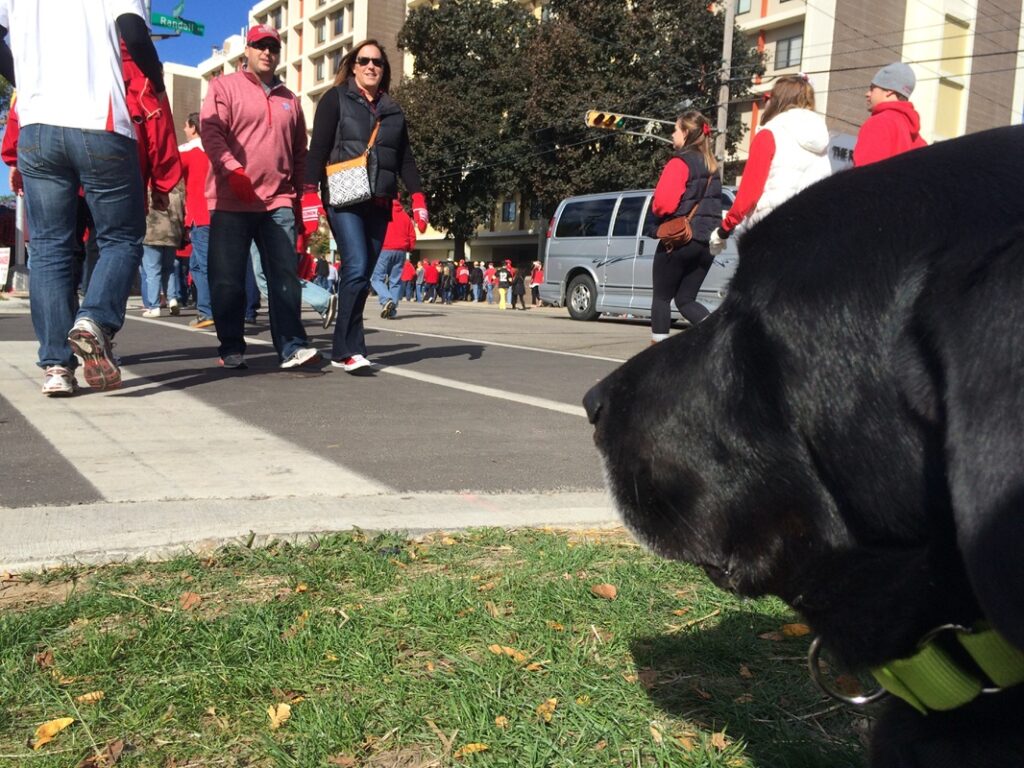
In dog training, it means practicing in a wider variety of environments, so a dog understands that a training cue in one location means the same in other locations. The goal is to achieve fluency: “OK, got it!”
The Proof is in the Proofing
Once our dogs understand known training cues in various locations, we must enter the proofing stage, in which we apply the Three D’s: distraction, distance and duration.
The best way to apply the Three D’s is one at a time and not bunched together. When adding any one of the Three D’s, understand that it’s now more challenging for your dog to respond to the cue. Prevent overwhelm and frustration (for both of you) by keeping sessions short, fun and upbeat.
So, if your dog understands to ‘wait’ on cue, you might add duration (time) but not add distance or distraction yet. On another occasion you might move to a more distracting location but keep the learner’s distance from the handler short and the requested duration brief.
Ultimately, you can combine all Three D’s and your dog will be able to focus on the important cue and ignore the rest.
Many folks might fail to engage in proofing, because nobody ever taught them about it.
In this short video of ‘Daily Training with Distractions,’ Buddha and Gandhi play training games as part of our proofing process.
It’s a Partnership
Buddha and Gandhi each enjoyed a six-week basic manners course taught by a force-free trainer, followed by a six-week intermediate course, and a six-week advanced course.

The advanced course was taught in outdoor environments such as public parks. The dogs were asked to respond to various known training cues in the face of distraction, increased distance and longer duration. And guardians were shown how to assess their pets for any signs of distress in these potentially challenging situations and how to advocate for their pets’ emotional well-being when/if necessary.
As our homework, we practiced each day in many locations. Because our dogs thrived when joining us on outings, our proofing process involved taking them to public events, novel neighborhoods, community celebrations, college football games, and water ski shows.
Our real-world training with distractions sometimes meant ignoring thousands of rowdy football fans, with live music and food vendors. Other times it meant ignoring hundreds of fans cheering the 45 skiers performing behind five roaring speed boats, along a causeway with heavy vehicle traffic, in a noisy downtown area with emergency sirens and occasional freight train traffic. Oh, and then there were the ducks on the lake!
Easy-peasy, because we systematically prepared them for “real-world” situations and our reward-based training never failed us.
Regarding prey drive, Buddha was always off-leash on our property and I called him away from chasing deer, coyote, squirrels, rabbits, woodchucks, skunk, opossum, turkeys and songbirds to name a few wildlife. He always came running back to me with a huge smile, even though I seldom had a treat to offer him. What we had…was a long reinforcement history of reward-based training.
From Preschools to Nursing Homes
Because the dogs continued to show they truly enjoyed participating in fun training (as did I), we then enrolled in a six-week course in agility, followed by a six-week course in rally.
Upon completing that, we engaged in therapy team preparation.
Therapy visits were additional “real-world” experiences including bite-prevention classes for pre-school and grade school kids, college visits at exam time, nursing homes, and correctional facilities.
During one visit to a nursing home that was under noisy renovation for months, workers knocked down a wall while Buddha and Gandhi were about 20 feet away. I was more surprised by that than they were! I never carried treats during therapy visits, yet all the while, they remained calm (but not shut down) and responsive to training cues…in the “real world.”
Closing Thoughts
One thing I never had the opportunity to call my dogs away from was the scourge of internet Trolls, but I expect they would happily have turned away from such doomsayers.
My advice to pet stewards is to be mindful when perusing social media posts.
Understand the difference between science-based philosophy that places pet welfare at the pinnacle, and posts slinging personal insults in defense of methods and equipment proven to harm pets.
In my view, you and your pet deserve proof of ethics and transparency.
About the Author
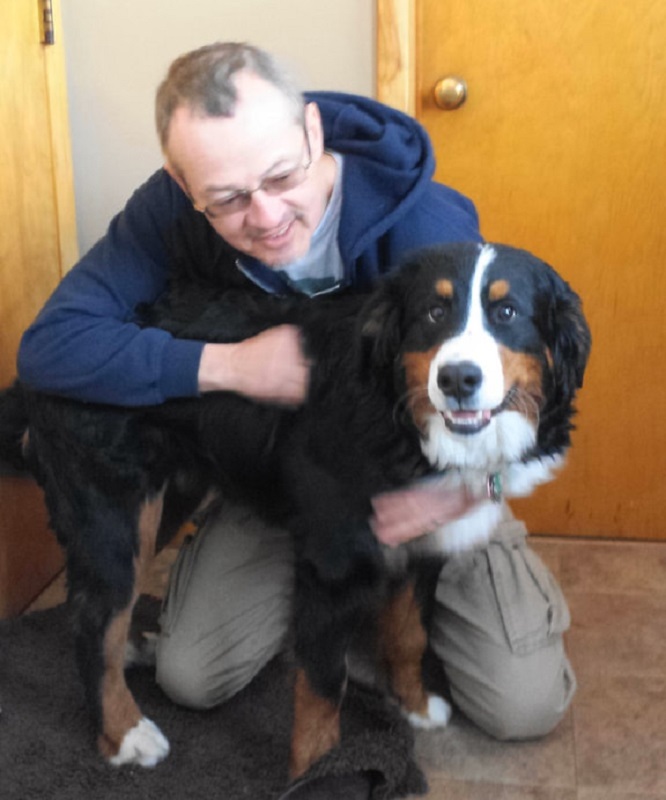
Daniel H. Antolec, PCT-A, CCBC-KA, CPDT-KA began teaching dogs in 2011 and founded Happy Buddha Dog Training. He teaches dogs in a way that makes it fun for pet stewards and pets alike.

Pets and Their People Blog
Topics
Archives