


Fighting Like Cats and …Cats?
by Misty Hampton
When it comes to multi-cat homes, a variety of factors may influence whether cats will get along in the long run. The initial introduction can be the deciding factor.
New Cat Introductions
A significant number of cats will fight when a new cat is brought into the home. In one survey, about half of the multi-cat households reported fighting between cats when the new cat was introduced. Cats who fought when they first met (biting or scratching) were more likely to still be fighting up to a year later (Levine et. al, 2005). Another study found that, in multi-cat households where conflict was reported, over 73% noted conflict signs from the very beginning when introducing the cats (Elzerman et. al, 2019).
That’s why it’s so important to set up for success from the start!
Realistic Expectations
It’s crucial to remember that free-ranging cats can choose to leave an undesirable social situation, whereas companion cats (especially indoor-only cats) cannot. Cats living in a multi-cat home have their roommates chosen by their caregivers. They don’t automatically form bonded social groups (Rodan et. al, 2024).
A gradual introduction process is recommended, especially when introducing mature cats (5 + years) to each other (Hoff et. al, 2025).
When I say “gradual,” expect it to take weeks or months, not just a few days.
You may have been lucky with cats in the past, but successful quick introductions are the exception, not the rule, with adult cats.
Some Tips for Starting Off Right
“[T]ypically, intercat tension within a home occurs because there is competition over resources,” or something is threatening the social relationships within the group – introduction of a new cat, territorial invasion by an outdoor cat, or pain or sickness (Rodan et. al, 2024). One study found that 97.5% of aggressive encounters centered around food (Vitale, 2022).
This is one reason why using mealtime for introductions is a bad idea!
To prevent conflict, ensure that there are plenty of resources (food and water, litter boxes, scratching posts, elevated perches, toys and play areas, beds/resting areas, hiding places, etc.) spread out around the house to eliminate the need for competition.
“Plenty” of resources means one per cat plus one, ideally (or the number of social groups plus one, for homes with a larger number of cats). For instance, two cats need a minimum of three litterboxes.
Each cat will establish their own territory. It’s important that resources be spread out around the house so that each cat can access everything they need without having to cross through another cat’s core territory. They can interact in the neutral areas if they choose, or they can avoid the other cats if they prefer (Crowell-Davis et. al, 2019 and iCatCare, 2025).
Feline Social Dynamics
So, how do you know if the cats have a good relationship?
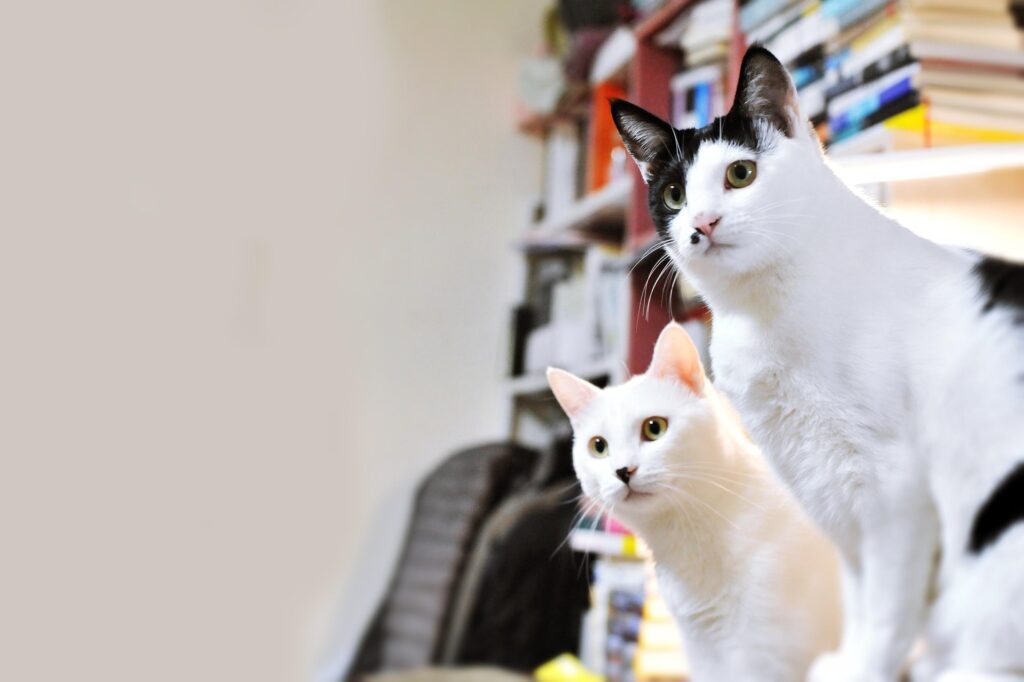
Positive signs: When two cats greet each other with tails up, rub against each other, head-butt against each other (called bunting), often groom each other and sleep in close contact with one another, that means they have a good relationship. You shouldn’t be too concerned if there is an occasional mild negative exchange, such as swatting or nipping each other at the end of a grooming session.
Negative signs: Staring at each other with tails lashing, one cat chasing the other (not taking turns), hissing and screaming, fur flying and visible scratches are clear signs of a negative relationship. When cats are fighting like this, even if it’s infrequent, it’s a serious safety risk. If one of the cats gets injured, or if you get injured trying to get between them (please don’t, by the way! use a heavy blanket or a piece of cardboard instead), the best-case scenario is an expensive medical bill. It’s better to separate them, before the situation gets worse.
Something in between: A strong negative relationship is often obvious, but a slightly negative or neutral relationship is harder to identify. If the cats sleep near each other but aren’t actually physically touching, they don’t often nose-touch, head-butt (bunt), or rub against each other, and their interactions are rarely mutual, they may have a neutral relationship. That’s fine if they mostly avoid each other. However, if one cat often corners another and there is hissing and growling, then there is likely tension in their relationship, which can be harmful for their well-being in the long run (Gajdoš-Kmecová et. al, 2023).
Playing or Fighting?
Cats play rough, so it can be hard to tell if they are playing or fighting.
Like any relationship, it’s not black and white. It’s definitely a spectrum, and we need to look at the big picture – considering behavior patterns in context and over time – to really be able to tell.
If they take turns chasing and there is no vocalization, and especially if you see a butt-wiggle, then it’s most likely play.
Another key indicator is if the cats go back for more afterward, or if they seem to stay agitated. If they are eager to get back together, then they have a good relationship.
Be mindful that sometimes it’s a game for one cat, but it’s stressful for the other.
Or, sometimes, what starts out as play can get a little carried away. When that happens, the cats can communicate that they’re done playing. You don’t need to be concerned unless one cat hisses and the other cat won’t back off. That could mean that that cat needs to learn some communication skills, perhaps through force-free training.
What If It Doesn’t Work Out?
If you suspect your cats have a negative relationship, whether that’s slightly negative or strongly negative, you have some options:
- Reach out to a cat behavior professional who can help you work through a reintroduction process.
- Decide to keep the cats in separate parts of the home long-term.
- Find a new home for one or more cats.
Even when we try our best to make thoughtful matches, it doesn’t always work out. Sometimes, bonded pairs break up after a stressful move to a new home. Other times, cats who were once best friends will have a falling out once they reach social maturity. (That happened for my cats, Linus and Jasper.)
When that happens, we need to think about what will give all the cats the best welfare. That might mean separate territories within the home, or finding a new home for one of the cats. It’s not good for anyone to keep living in a stressful home environment. Although it’s not the outcome we would wish for, it’s still a happy ending when the cat has the opportunity to thrive in a different environment.
About the Author
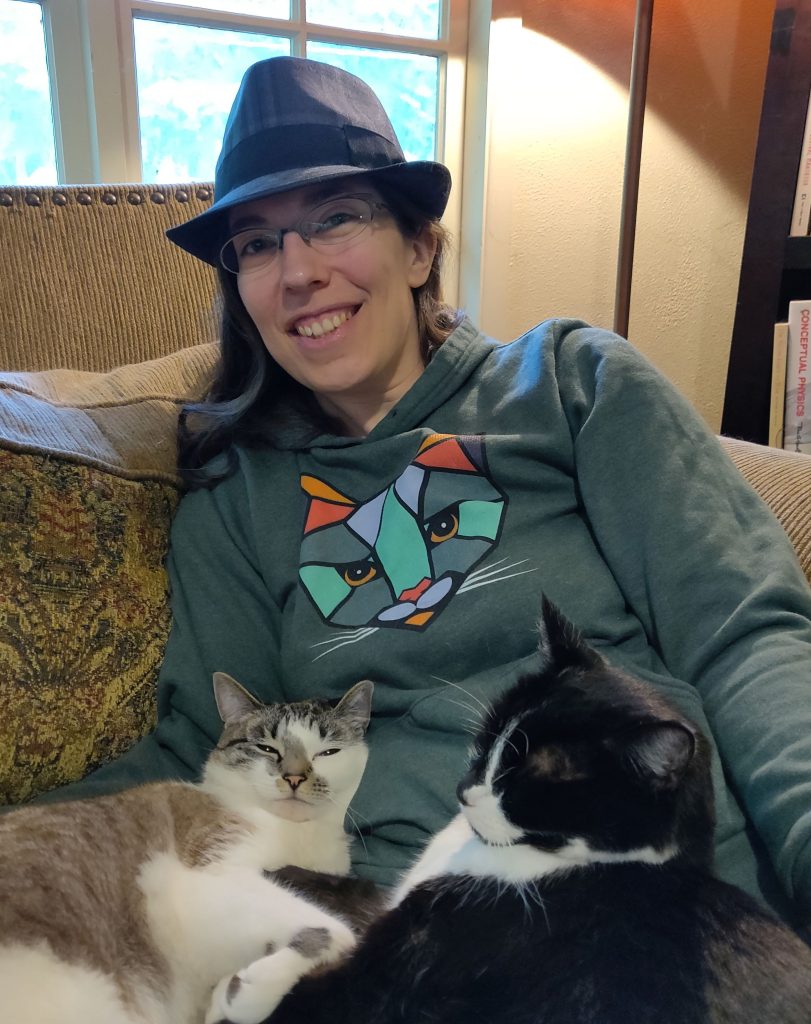
Misty Hampton (CCBC, FFCP) is a cat trainer and behavior consultant and owner of Fellow Creatures Pet Consulting. She started teaching at age 12. For 13 years, she was an instructor for a home-schooling community. Since 2001, she has been a math and science tutor. Now, she is a life coach for teens and young adults as well. She also runs a birding club for Lake Oswego Parks & Recreation.
Her passion is helping people better understand misunderstood animals. She shares her life with her husband Jesse and their five cats: Linus, Jasper, Abigail, Pearl, and Piper.
References & Resources
Crowell-Davis, S. L., Curtis, T. M., & Knowles, R. J. (2004). Social organization in the cat: A modern understanding. Journal of Feline Medicine and Surgery, 6(1), 19–28. https://doi.org/10.1016/j.jfms.2003.09.013
Elzerman, A. L., DePorter, T. L., Beck, A., & Collin, J.-F. (2019). Conflict and affiliative behavior frequency between cats in multi-cat households: a survey-based study. Journal of Feline Medicine and Surgery, 22(8), 1098612X1987798. https://doi.org/10.1177/1098612×19877988
Gajdoš-Kmecová, N., Peťková, B., Kottferová, J., Halls, V., Haddon, C., de Assis, L. S., & Mills, D. S. (2023). An ethological analysis of close-contact inter-cat interactions determining if cats are playing, fighting, or something in between. Scientific Reports, 13(1), 92. https://doi.org/10.1038/s41598-022-26121-1
Hoff, A., Czycholl, I., Lund, T. B., Mills, D., Serpell, J., & Sandøe, P. (2025). Introducing new cats to multi-cat households: Results of a representative survey of Danish cat owners. Applied Animal Behaviour Science, 293, 106855. https://doi.org/10.1016/j.applanim.2025.106855
International Cat Care. (2025). The social structure of cat life. Icatcare.org. https://icatcare.org/articles/the-social-structure-of-cat-life#understanding-the-social-structure-of-cats
Levine, E., Perry, P., Scarlett, J., & Houpt, K. A. (2005). Intercat aggression in households following the introduction of a new cat. Applied Animal Behaviour Science, 90(3-4), 325–336. https://doi.org/10.1016/j.applanim.2004.07.006
Rodan, I., Ramos, D., Carney, H., DePorter, T., Horwitz, D. F., Mills, D., & Vitale, K. (2024). 2024 AAFP intercat tension guidelines: recognition, prevention and management. Journal of Feline Medicine and Surgery, 26(7). https://doi.org/10.1177/1098612×241263465
Vitale KR. The Social Lives of Free-Ranging Cats. Animals (Basel). 2022 Jan 5;12(1):126. doi: 10.3390/ani12010126. PMID: 35011232; PMCID: PMC8749887

Pets and Their People Blog
Topics
Archives