

How We Talk About Dogs: What Does Our Language Reveal?
by Louise Stapleton-Frappell
Language shapes how we think, how we teach, and how we relate to the world — and that includes our dogs.
This isn’t “just semantics.” The way we talk about dogs reflects the ethics, empathy, and science behind how we teach them skills to live successfully in our human world.
Commands vs. Cues – More Than Just Words
You don’t need to bark “commands” at your dog to train them. You don’t need to be a “pack leader,” issue “orders,” or demand submission.
You don’t need to dominate to teach.
Modern, force-free training has moved far beyond this outdated thinking. We now understand that language frames intention.
- Words like command suggest control, compliance, and authority.
- Words like cue suggest communication, cooperation, and choice.
It’s easy to see which of these creates a more trusting, emotionally safe learning environment.
A dog who responds because they understand and want to participate learns faster and with more confidence than one who “obeys” out of fear or confusion.
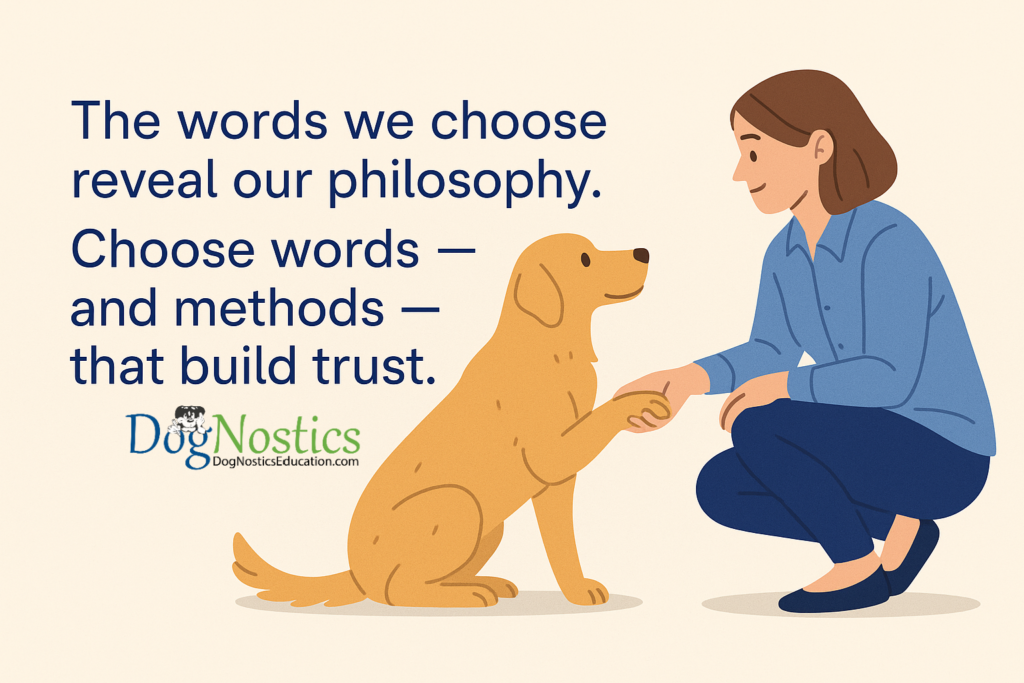
The words we choose reveal our philosophy. Choose words — and methods — that build trust.
Changing our language from command to cue isn’t wordplay; it’s a mindset shift. It reflects a philosophy based on partnership rather than power.
From “Obedience” to Learning Life Skills and Confidence
In earlier years, I often talked about teaching “tricks” instead of “obedience behaviors.” Framing training that way helped people understand that while we may teach specific skills, training can — and should — also be fun.
These days, I might not use the word trick as a synonym for a training skill, but I often talk about training games — even when referring to essential behaviors such as coming when called, waiting when asked, or walking nicely without pulling.
Training games make learning enjoyable for both dog and guardian. They are designed to build real-world confidence, optimism, and resilience — qualities that go far beyond sitting or staying.
When dogs learn through engaging, low-pressure experiences, they become curious, willing problem-solvers who trust the learning process and, importantly, you- the person guiding them.
Myth Busting: Pack Theory, Dominance, and the “Alpha Dog”
The notion that we must act as “alpha” or “pack leader” to earn a dog’s respect has long been discredited.
This myth came from outdated wolf studies based on captive groups that behaved nothing like natural family wolf packs. Even Dr. David Mech, whose early work popularized the concept, has since clarified that wild wolf families are cooperative, not competitive hierarchies.
Dogs are not wolves — and even wolves aren’t the animals those early studies described.
Our dogs are family members and learning partners, not subordinates. Training them should be about understanding, safety, and mutual respect — not control.
Training through intimidation or physical dominance isn’t just unnecessary; it risks damaging both trust and well-being.
Choosing an Ethical Trainer
When choosing a professional to guide you and your dog, a useful question to ask yourself is simple:
Would I want to be taught this way?
If the answer is no, your dog shouldn’t be either.
To help you find a professional who uses science-based, compassionate methods, here are two organizations that I don’t hesitate to recommend — each one plays a unique role in supporting ethical, force-free training and education:
The Pet Professional Guild (PPG)
PPG is a membership organization representing pet industry professionals who are committed to results-based, science-based, force-free training and pet care. Members agree to uphold PPG’s guiding principles, which mean no shock, no choke, no prong, no fear, no pain, and no intimidation.
(Note: Pets and Their People is a publication of the Pet Professional Guild.)
The Pet Professional Accreditation Board (PPAB)
PPAB is an independent credentialing body that provides the only psychometrically developed certification for professionals who believe there is no place for coercion or aversive tools in training. Accredited practitioners are rigorously tested in areas including learning theory, ethology, communication, development, consulting skills, and scientific method. A PPAB credential demonstrates verified competence in humane, evidence-based practice.
About the Author
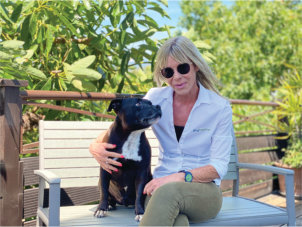
Louise Stapleton-Frappell – B.A. Hons. PCBC-A. PCT-A. CAP3. CTDI. CWRI. DN-FSG2. DN-CPCT2. FFCP, Professional Canine Behavior Consultant and Trainer – Accredited by the Pet Professional Accreditation Board , Co-Partner and Faculty Member of DogNostics Career Center, and Board Member of The Pet Professional Guild.
Louise’s experience, her background as a teacher and her impressive pet industry credentials, means she is uniquely qualified to share her skills and knowledge with both the public and pet industry professionals. The creator of the DogNostics Dog Trainer Certification Program, Louise has presented at conferences internationally and has gained a reputation for expertly teaching and training humans and canines at her own establishment, The DogSmith of Estepona , in Southern Spain. Louise has published numerous articles on dog training and dog behavior and is also the published co-author of the following titles, A Lexicon of Practical Terms for Pet Trainers and Behavior Consultants, Pet Training and Behavior Consulting: A Model for Raising the Bar to Protect Professionals, and is a Pets and Their People contributor.
This post was originally published in BARKS from the Guild (Stapleton-Frappell, 2015). Updated and expanded for 2026 with current perspectives from DogNostics Education.
DogNostics Education is a Pet Professional Guild Corporate Partner.

Pets and Their People Blog
Topics
Archives