

Kindness and Cooperation: A Promise to Our Pets
by Niki Tudge
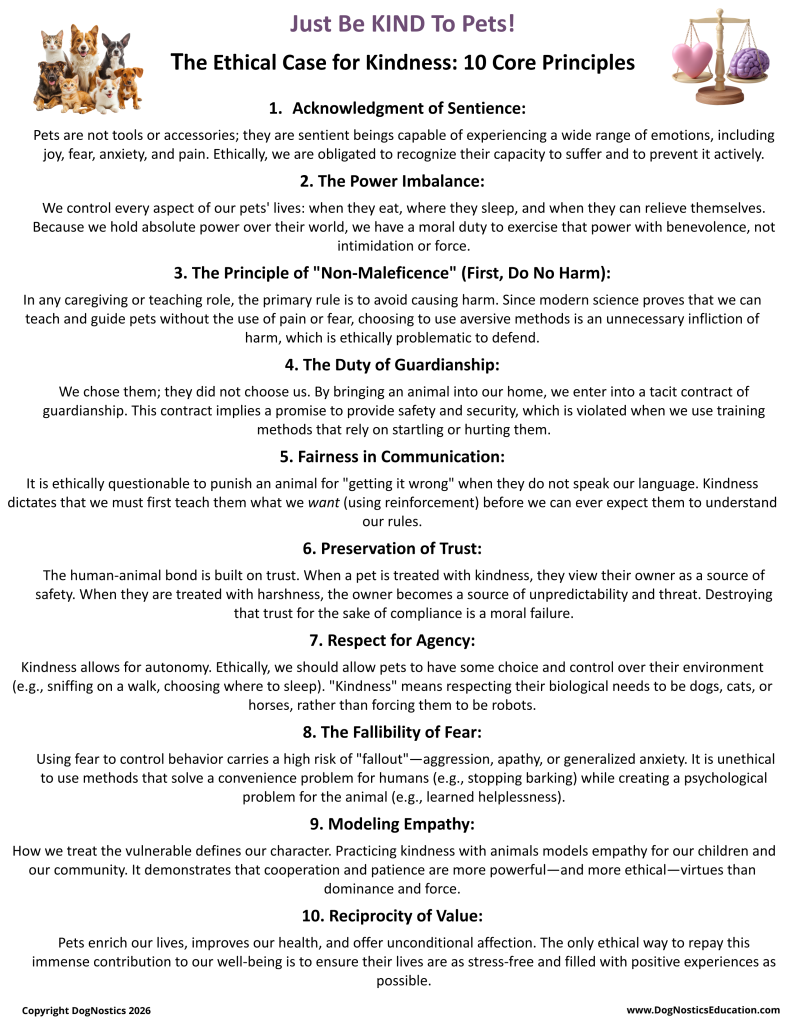
The Ethical Case for Kindness: Ten Core Principles
1. Acknowledgment of Sentience: Pets are not tools or accessories; they are sentient beings capable of experiencing a wide range of emotions, including joy, fear, anxiety, and pain. Ethically, we are obligated to recognize their capacity to suffer and we are obligated to actively prevent their suffering.
2. The Power Imbalance: We control every aspect of our pets’ lives: when they eat, where they sleep, and when they can relieve themselves. Because we hold absolute power over their world, we have a moral duty to exercise that power with benevolence, not intimidation or force.
3. The Principle of “Non-Maleficence” (First, Do No Harm): In any caregiving or teaching role, the primary rule is to avoid causing harm. Since modern science proves that we can teach and guide pets without the use of pain or fear, choosing to use aversive methods is an unnecessary infliction of harm, which is ethically problematic to defend.
4. The Duty of Guardianship: We chose them; they did not choose us. By bringing an animal into our home, we enter into a tacit contract of guardianship. This contract implies a promise to provide safety and security, which is violated when we use training methods that rely on startling or hurting pets.
5. Fairness in Communication: It is ethically questionable to punish an animal for “getting it wrong” when they do not speak our language. Kindness dictates that we must first teach them what we want (using reinforcement) before we can ever expect them to understand our rules.
6. Preservation of Trust: The human-animal bond is built on trust. When a pet is treated with kindness, they view their guardian as a source of safety. When they are treated with harshness, the person becomes a source of unpredictability and threat. Destroying that trust for the sake of compliance is a moral failure.
7. Respect for Agency: Kindness allows for autonomy. Ethically, we should allow pets to have some choice and control over their environment (e.g., sniffing on a walk, choosing where to sleep). “Kindness” means respecting their biological needs to be dogs, cats, or horses, rather than forcing them to be robots.
8. The Fallibility of Fear: Using fear to control behavior carries a high risk of “fallout”—aggression, apathy, or generalized anxiety. It is unethical to use methods that solve a convenience problem for humans (e.g., stopping barking) while creating a psychological problem for the animal (e.g., learned helplessness).
9. Modeling Empathy: How we treat the vulnerable defines our character. Practicing kindness with animals models empathy for our children and our community. It demonstrates that cooperation and patience are more powerful—and more ethical—virtues than dominance and force.
10. Reciprocity of Value: Pets enrich our lives, lower our blood pressure, and offer unconditional affection. The only ethical way to repay this immense contribution to our well-being is to ensure their lives are as stress-free and filled with positive experiences as possible.
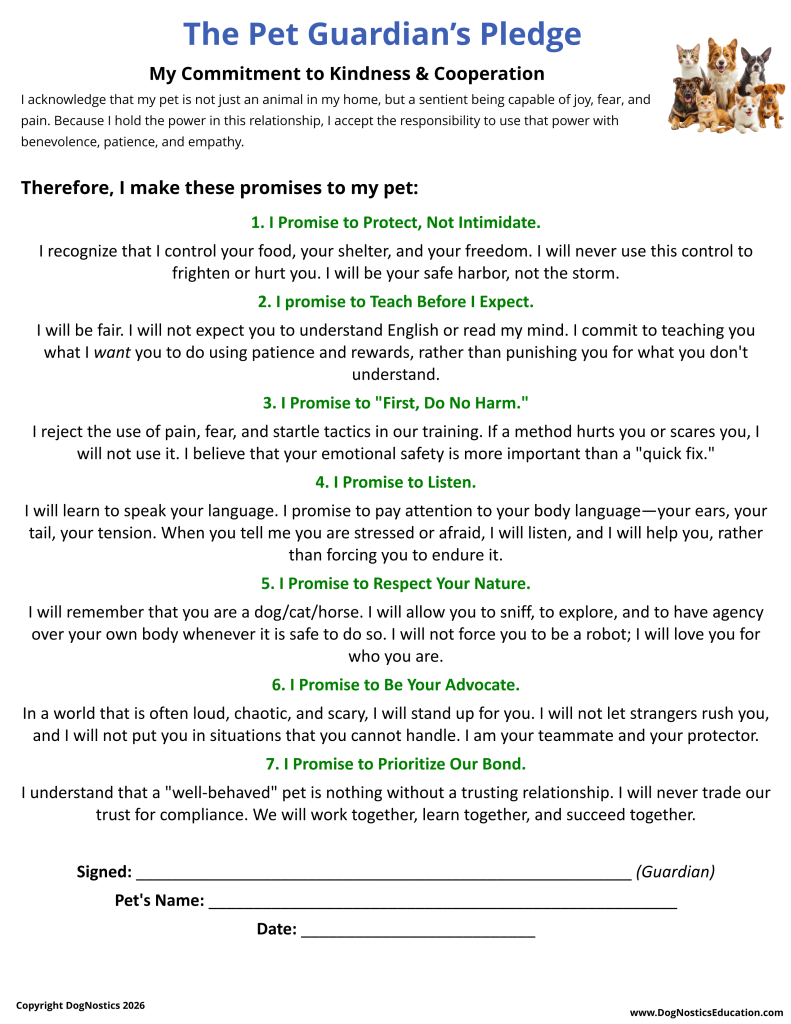
The Guardian’s Pledge: A Commitment to Kindness and Cooperation
I acknowledge that my pet is not just an animal in my home, but a sentient being capable of joy, fear, and pain. Because I hold the power in this relationship, I accept the responsibility to use that power with benevolence, patience, and empathy.
Therefore, I make these promises to my pet:
1. I Promise to Protect, Not Intimidate. I recognize that I control your food, your shelter, and your freedom. I will never use this control to frighten or hurt you. I will be your safe harbor, not the storm.
2. I Promise to Teach Before I Expect. I will be fair. I will not expect you to understand English or read my mind. I commit to teaching you what I want you to do using patience and rewards, rather than punishing you for what you don’t understand.
3. I Promise to “First, Do No Harm.” I reject the use of pain, fear, and startle tactics in our training. If a method hurts you or scares you, I will not use it. I believe that your emotional safety is more important than a “quick fix.”
4. I Promise to Listen. I will learn to speak your language. I promise to pay attention to your body language—your ears, your tail, your tension. When you tell me you are stressed or afraid, I will listen, and I will help you, rather than forcing you to endure it.
5. I Promise to Respect Your Nature. I will remember that you are a dog (cat/pet). I will allow you to sniff, to explore, and to have agency over your own body whenever it is safe to do so. I will not force you to be a robot; I will love you for who you are.
6. I Promise to Be Your Advocate. In a world that is often loud, chaotic, and scary, I will stand up for you. I will not let strangers rush you, and I will not put you in situations that you cannot handle. I am your teammate and your protector.
7. I Promise to Prioritize Our Bond. I understand that a “well-behaved” pet is nothing without a trusting relationship. I will never trade our trust for compliance. We will work together, learn together, and succeed together.
About the Author

Niki Tudge – M.B.A, PCBC-A, CABC, CDBC
As the founder and President of The Pet Professional Guild, DogNostics Education, and The DogSmith, Niki Tudge brings substantial leadership experience to the pet industry. She has published numerous articles on dog training and behavior, and her businesses have been featured in publications such as the New York Times.
Niki’s professional credentials include AABP-Professional Dog Trainer, AABP-Professional Dog Behavior Consultant, and both PCBC-A and PCT-A accreditation through the Pet Professional Accreditation Board. She also holds diplomas in Animal Behavior Technology and Canine Behavior Science & Technology from the Companion Animal Science Institute.
Combining her industry expertise with a strong business foundation, Niki holds a business degree and an MBA from Oxford Brookes University. She is also a certified Six Sigma Black Belt, an HCITB TS1, TS2 & TS3 certified people trainer, a Certified Facilitator, a Certified Transformation Specialist, and a Project Manager.

Pets and Their People Blog
Topics
Archives